16 September 2006

And Beat Them Lightly

Having first heard of this via Popbitch, I didn't know how seriously to take a report that Islamic Society of North America's recent convention in New York offered a workshop on the properly Islamic way to beat your wife. But on taking a quick look around the interweb, I discovered that this "Analysis and In-Depth Discussion of Verse 4:34" had been widely reported.

I also discovered a thoughtful commentary by one scholar, Dr Ahmad Shafaat, urging that before using physical violence to discipline recalcitrant wives, husbands first "admonish them," and then "separate them in beds." But, he goes on to say:
If even separation fails to work, then it is suggested that men use beating. To this suggestion of the Holy Qur'an there have been two extreme reactions on the part of some Muslims. The first reaction is being apologetic or ashamed of the suggestion. The second is to use it as a justification for indulging in habitual wife battering. Needless to say that both these reactions are wrong. The Quran as we believe is the word of God and is thus every word in it is full of wisdom and love. To be apologetic about any part of the Quran is to lack both knowledge and faith. As for the second response, the suggestion to use beating is made specifically to deal with nushuz on the part of the wife, that is, to deal with her deliberately nasty behaviour that poses a threat to the marriage. Beating is to be done after due admonition and separation in beds and therefore by husbands who have some moral standards and have sufficient control over their sexual passions. Moreover, this beating is not to go on and on but is to be tried as a last step to save the marriage. Once it is clear that it is not working it is to be abandoned in favour of some other steps involving relatives of the husband and the wife mentioned in the next verse (4:35). There is therefore, absolutely no license here for the type of regular and continual wife beating that goes on in some homes, where each time the husband is angry with his wife or with someone else he turns against her and beats her up. In most such cases, the husband has no moral superiority over the wife: the only rule of Shariah that he cares about is this suggestion about beating. He also does not have the kind of control over his sexual passions needed to separate the wife in bed and often beats her the day before or the day after making love to her, an action specifically condemned by the Prophet.
He also offers some helpful suggestions on proper technique, noting that:
According to some traditions the Prophet said in his famous and well-attended speech on the occasion of his farewell pilgrimage that the beating done according to the present verse should be ghayr mubarrih, i.e. in such a way that it should not cause injury, bruise or serious hurt. On this basis some scholars like Tabari and Razi say even that it should be largely symbolic and should be administered "with a folded scarf" or "with a miswak or some such thing". However, to be effective in its purpose of shaking the wife out of her nasty mood it is important that it should provide an energetic demonstration of the anger, frustration and love of the husband. In other words, it should neither seriously hurt the wife nor reduce it to a set of meaningless motions devoid of emotions.
In a perhaps unrelated, but still amusing footnote, Popbitch also reports the tale of one Mustafa Moufaden from Brentford, West London, who:
was flying from Shanghai to London when Virgin Atlantic staff refused to serve him more alcohol as he was so drunk. Mustafa did what every right thinking Muslim chap would do under the circumstances...he shouted at them that he knew Osama Bin Laden, and would tell on them if they didn't give him booze. He's now in trouble.

Fair Play For Criminals

Yes, I know the Daily Mail has a reputation for being a hotbed of xenophobic, right-wing tosh, but as someone who's faithfully imbibed the left-wing drivel of the Guardian for well-nigh 30 years now, it only seems fair to balance my intake by reading some nonsense from the opposite end of the political spectrum. Besides, say what you will about its content, the Mail frequently contains more entertainment than the dour maunderings of the Guardian or Independent can muster.

But even taken with the requisite grain of salt, this latest "PC run mad" alert from the Mail has to raise an eyebrow. Policemen are to be banned from chasing criminals if the chase might put the criminals at risk of injuring themselves. This from the same bright sparks who just awarded a lucrative promotion to the officer who oversaw the summary shooting to death of an illegal Brazilian immigrant somehow mistaken for a Middle Eastern suicide bomber.

Cressida Dick, the officer in question, narrowly escaped prosecution for her handling of that case, and may still face disciplinary proceedings within her own department. But never mind that, she's a woman, she's believes in "modernisation" of the Police, and, what hey, she's mates with the Police Commissioner, what a surprise.

Besides that, according to her official bio, "Cressida’s policing interests include public order, hostage negotiation, leadership, police ethics and diversity." Well, that's okay, then, as long as she's in favour of diversity. True, giving South Americans the same opportunity to be shot as Middle Eastern terrorists might not be some people's idea of true diversity, but perhaps Jean Charles de Menezes' mistake was in simply sitting there on the Tube while the police rushed up and pumped six bullets into him. If he'd behaved like a proper criminal and run away, ideally in a dangerous fashion, the police would have had to abandon the chase for fear of breaching Health and Safety regulations.

Body Fascism

Granted that anorexia and bulimia cause enormous misery and even death in some cases, and granted that many young women go overboard in the pursuit of perfectly fashionable thinness, does it really seem like banning skinny models is a sensible way to go about tackling the problem?

For years now, columnists of the Guardianista ilk - many of them, if the truth be told, middle-aged women who've begun to put on a little more weight than they might like - have been banging on about "stick-thin waifs" and protesting that they can no longer find fashionble clothing to fit their more "womanly" bodies. From time to time male columnists flying the PC flag will join in, protesting that they themselves prefer woman with "real curves" and "a bit of flesh on them." Underpinning all this nonsense is the implication that girls and young women are so stupid and gullible that they'll deliberately starve themselves either because of some fashion show they've seen or because men won't want to bother with them otherwise.

It seems as though society is becoming a bit schizophrenic on this subject. On one hand, we're constantly being told - legitimately, I think - that America is literally eating itself to death. Obesity is at an all time high in the USA, and the UK is fast following - well, waddling, anyway - in its footsteps. Yet simultaneously we're meant to be worried that one segment of society is entirely too thin, to the point where "liberal" politicians are seriously discussing banning the representation of women with what they deem to be too low a body mass.

Never mind that the BMI (body mass index) is a notoriously blunt instrument (it doesn't account for bone structure, metabolism and a host of other variables). And I wonder, too, why this concern is limited to young women. I can personally think of three guys I know whose body mass falls well below the 18.0 threshold considered "dangerous." All of them are perfectly healthy, and one of them completely thrashed me when we got into an ill-advised wrestling match a few years back.

Personally, as someone whose own BMI is (thankfully) near the lower end of what's considered normal for men my age, I think the great majority of people are too fat, and that given the preponderance of medical evidence, that's a far greater danger to public health than a few ultra-skinny girls. For all the whingeing by the mutton-aspiring-to-lamb generation about not being able to fit into the fashions at Top Shop (hello, it's a shop for teens and 20-somethings, what did you expect?), I could come back with just as many stories about being unable to find jeans or shirts that aren't cut for lard-arses.

Somebody once defined fascism as the imposition of aesthetic standards by political means, and I'm sorry, trying to legislate skinniness out of existence comes dangerously close to qualifying.

Big Ears And His Bentley

I've always had a bit of a soft spot for Prince Charles (often referred to, lovingly or not, as "Big Ears" by some of his subjects, like Vera from Coronation Street). Maybe it's because we were born around the same time, perennially feel put upon and misunderstood, are frequently the objects of ridicule, and more often than not are the authors of our own troubles. Yep, apart from the couple billion pounds he finds himself lumbered with, Charlie and I are almost peas in a pod.

Well, maybe not. I'm so ridiculously devoted to public transport that most of the time I won't even take taxis (well, that might also be because I'm cheap), whereas the Prince, Hardcastle's column in the Daily Mail informs us, can't bear to be separated from his 10 mpg Bentley (this, let it be remembered, is the "environmentalist" prince). So much so that when his own Bentley was out of commission, he had his staff ring up the Bentley company and ask that a loaner Bentley be delivered to him (any of you Toyota/Chevy/Nissan/Ford drivers ever tried this?).

The only suitably royal Bentley available was at the other end of the country, but somebody drove all night to get it to the palace on time. Charles came down to inspect it, took one look, and sniffed, "It's black. I hate black. We'll take the Vauxhall."

Is The Pope A Dope?

Although I'm Catholic, I haven't been too impressed by the last couple of Popes, so I've largely chosen to ignore them. Sure, maybe that goes against Church doctrine - or maybe it doesn't, since the concept of Papal infallibility was invented by - guess who? - a Pope - but just as I'm not going to stop being American because we get the occasional lousy President, I'm not going to let a doofy Pope drive me away from my religion.

That being said, what in hell is the Pope up to with his "let's rile up the Muslims" remark? Even accepting that there's some truth to it - no reputable historian would deny that Islam was imposed on many countries by military conquest, but then quite a few "Christian" countries were made that way by imperial fiat as well - it seems at best impolitic of him to bring it up at a time when millions of Muslims have recently shown themselves ready to resort to murderous violence over a handful of dumb cartoons.

It seems on the surface a bit like the medieval "sport" of bear-baiting: poke a stick into the cage of a creature who's already having a bad time of it just for the amusement of hearing it roar. Is the Pope really that dumb? Or sadistic? Or is he up to something too abstruse or esoteric for us garden-variety pseudo-intellectuals to grasp?

The sentence that's got everyone up in arms - "Show me just what Muhammad brought that was new, and there you will find things only evil and inhuman, such as his command to spread by the sword the faith he preached" - is only a tiny extract from a lengthy and erudite speech (a longer extract is available here and the whole thing here) that seems to revolve around the question of whether the will of God can run counter to reason.

It's fairly heavy going, and does seem to carry a whiff of what one of the Guardian's pet theologians called "Christian triumphalism," particularly when the Pope cites the "profound encounter of faith and reason is taking place here, between genuine enlightenment and religion . . . between biblical faith and Greek philosophical inquiry" as one of the reasons Christianity has played such a decisive role in European and world history.

But most of the speech is concerned with weightier philosophical matters, which on the surface might sound like little more than a high-faluting version of the old, "Can God make a rock so big he can't lift it?" conundrum, but ultimately go right to the heart of our understanding (or lack thereof) of the interface between divine and human nature. Put as simply as possible, he questions whether irrational actions like burning witches, imposing fatwas on authors or cartoonists, or waging war to compel devotion, could be consonant with the will of any God worth worshipping.

He even brings in Socrates to defend the value of philosophy in the face of a ever-rising tide of bagglegab: "It would be easily understandable if someone became so annoyed at all these false notions that for the rest of his life he despised and mocked all talk about being - but in this way he would be deprived of the truth of existence and would suffer a great loss." Clearly the Pope is no dummy - something I might have previously suspected, but hadn't given much thought to - even if he's lacking in tact and social graces. But then people of his age are - much like children - renowned for dropping the niceties and saying exactly what they think without regard for the consequences.

Apart from all the philosophical and theological ruminations, does the remark which has so many Muslims up in arms amount to anything more than a version of, "Our religion's better than yours"? No, not really, and here's where the hypocrisy sets in: is there a devout Muslim, Jew, Christian, Buddhist, Hindu, etc. who doesn't think his or her religion is superior? Why else would they bother having separate religions? Nobody thinks it even slightly remarkable when Muslim leaders or theologians state that Islam is the highest expression of God's will for humankind; why should it be so shocking that a Christian leader feels similarly about his own faith?

14 September 2006

White Riot

A nice bit of rose-coloured revisionism here, as yet another socialist "historian," one Alexander Billet, tries to turn the Clash from good, solid musicians and entertainers - which they were - into social visionaries and revolutionaries, which they most decidedly were not.

I wasn't at the Notting Hill riot of August, 1976, but I spent quite a bit of that year in Notting Hill and think it fair to say that I have a slightly more accurate picture of what it was like than Billet, who quite evidently was nowhere near the place. It's true that the Clash song "White Riot" was inspired by the largely black-led riot that erupted on the last day of that year's Carnival. It's also true that Joe Strummer, in his befuddled, trustafarian way, genuinely believed that the young black men showering the police with bricks and bottles were fighting back against oppression and in the vanguard of a revolution that whites like himself also be part of.

But that's where reality goes off a cliff and a couple generations of political fanatics and race-baiting fantasists take over. In truth, there was nothing remotely revolutionary or progressive about the Carnival riot; it could be more accurately described, like its Brixton counterpart in 1981, as a right-to-rob riot. In both cases, rioting broke out not because the police were unjustly harassing young black men - though that was not unheard of in those days - but because they were trying to stop them from engaging in rampant street robberies.

Billet writes, either naively or dishonestly, that, "The police presence [at the 1976 Carnival] was, of course, unnecessarily large." Only someone who never attended the Carnival in those days or who favours robbery as a legitimate means of income redistribution would say such a foolish thing; "steaming," where a large gang of black boys would go charging through the crowds mugging everyone in sight, was as much a part of the old-school Carnival as the costumes, the dancing and the spliffs. Olivia and her friends (all of whom loved the Carnival and hated the police) were knocked down and robbed by a marauding gang one year. I think she was about 70 at the time, and for years - hell, decades afterward, she was still describing how she tried explaining to the robbers that she wasn't like the other white people, she was on their side. And when the police came to see if she was all right, she gave them a good bollocking, insisting that any trouble at the Carnival was their fault, and that the young black men had no choice but to commit robberies because they were racially oppressed.

In other words, even though she was never much of a punk rocker (except maybe the kind with flowers in her hair), Olivia and Joe Strummer had a good deal in common: a visceral conviction than black people could do no wrong and policemen could do no right. But even today, when the Notting Hill Carnival has lost any political edge it may have once had and become little more than a drunkfest and tourist attraction, Mayor Ken - a huge supporter of Carnival himself - still finds it necessary to assign 10,000 coppers, a third of London's police force, to keep the peace. There haven't been any murders the last two Carnivals, and robberies are probably no worse than they are on a normal night in Notting Hill, so it appears to be working. Of course it's a enormous boon for criminals in the rest of London, which is left largely unpatrolled.

But I digress, and I've ranged so far afield from the topic that I might as well go even further and tell the story of the year Olivia and all her gay friends ("my lovely queens," she always called them) were partying away in the flat as Carnival raged and seethed (in a relatively benign way) on the street below. One of the queens started flirting with a copper stationed in front of our building, and wound up inviting him upstairs for a drink. To his surprise, the copper accepted, and brought along a couple of his mates. They were all hanging out on the balcony getting drunker and sillier by the minute, and inviting more and more coppers up until the whole upstairs of the flat was a sea of blue.

You might recall me saying that Olivia hated the police, but that was a general principle; as individuals - provided they weren't arresting her at the time - she got along with them just fine. So she played the gracious hostess, pointing to the fridge and telling each new arrival to help himself to whatever he could find to drink in there. Just then her son - who had a bit of history, shall we say, with the Old Bill - walked in and stood there with his mouth hanging agape.

"Mum..." he tried to say with a strangled voice, pointing at the fridge. "What's that, darling? Are we out of drinks? Be a dear and go buy some more," she said, waving some money in his direction.

"No, it's just that..." He went mute again, as three coppers rifled through the fridge in search of mixers and ice. It wasn't until the party was over that he was able to explain: aparently the fridge was where he'd been keeping his LSD stash, which was considerable. Whether or not any of it ended up in the coppers' drinks has yet to be determined. We think not, but it's not always easy to tell at Carnival time.

Anyway, to (sort of) return to my point, many crazy, beautiful and wonderful things happened during Carnival, as well as many brutal, ugly and violent things. But when sloganeers or songwriters try to turn it all into a simplistic parable of rebellion against oppression, it's a pretty safe bet they're either clueless white people slumming it, or cynical manipulators of the truth who are so desperate for a "revolution" to glom onto that they'll casually play toy soldiers with other people's lives.

12 September 2006

Islamophilia v. Islamophobia

As per my conversation with the Anonymous guy about why we do or do not need to fear the rise of aggressive, militant Islamism (what many call, and I think justifiably so, Islamofascism), here's an article by a diehard old leftist explaining why radical Muslims are actually rather cuddly and certainly much nicer than mean old George Bush and Tony Blair. The author is editor of the Socialist Worker, which, if you're not familiar with it, is that tabloid-looking newspaper with the bright red headlines that the sad-looking people with the haunted eyes are always trying to sell at demonstrations and outside various "youth culture" events.

Also, on the subject of "Islamophobia," which is supposedly running rampant in both Britain and the US, it's interesting to see that according to the New York Times, the USA is seeing a new wave of Muslim immigration. And of course Muslims continue to flock to the UK even as one of their self-appointed "leaders," Muhammad Abdul Bari warns that they are being "demonised." So much so, Dr Bari threatens, that Britain faces the prospect of two million homegrown suicide bombers.

A garden variety nutcase, you suggest? Not exactly; Bari, as head of Britain's Muslim Council, is what passes for a "moderate" these days, so much so that he has the ear of the Prime Minister and, I would be pretty certain, is the recipient of generous government grants.

Rhetoric aside, perhaps some logic would be of use here: if conditions are so bad for Muslims in Britain and the US, if those countries are, as they're frequently accused of doing, waging "war on Islam," why on earth would Muslims be immigrating en masse to such places? It would be like Jews lining up to move into Nazi Germany. Conversely, why do we so seldom hear of Muslims leaving the horrible oppression of the West and returning to one of the many countries partially or wholly dominated by Islam? Apart, of course, from the fact that it mostly sucks there?

And lastly, let's just try reversing the scenario: large numbers of immigrants of the Jewish or Christian persuasion emigrate into, say Iran or Saudi Arabia (as if they'd ever be allowed in the first place), then immediately start complaining that they're being "demonised" because of their religion and demanding that local laws and customs be changed to suit their beliefs. Can you see any other outcome apart from mass beheadings? Or maybe firing squads for greater efficiency.


Fighting Crime In The Streets Of Oakland (and Frisco)

Dr. Frank, who lives in a part of Oakland that I wouldn't, and who's been attacked, oh, at least a couple times that I'm aware of, finds himself bemused by that city's latest crime-fighting tactic: authorities have somehow determined who Oakland's "top 100 violent offenders" are, and are offering them a deal: either stop misbehaving, in which case they'll get job training and "other assistance to clean up their lives," or else the city will prosecute them "to the fullest extent of the law."

Pardon me for asking, but if city officials actually know who those top 100 violent offenders are, wouldn't they be guilty of criminal negligence for continuing to let them roam the streets? And doesn't this approach sound an awful lot like a befuddled parent shouting, "This time I really mean it!" at his recalcitrant offspring?

Speaking of which, across the Bay in that other oasis of civility, San Francisco, authorities are thinking about cracking down hard on that city's murderers and robbers by - get this - enforcing a midnight curfew on children aged 13 and under. Not to dismiss the problem of juvenile crime, and not suggest that a 12 or 13 year old has any business being out on the street after 9 or 10, let alone midnight, but how many murders have been committed by the 13-and-under crowd? And at any rate, you'd think a resourceful 13-year-old could get nearly all his killing done prior to the witching hour, wouldn't you?

As an indicator of the lunacy that reigns virtually supreme in Frisco politics, there are those opposed to enforcing the curfew on grounds that it is unfair to "youths in minority neighborhoods." Were you aware that there is some gene specific to "minority" children that forces them, like so many werewolves, to haunt the streets in the post-midnight hours? No, I wasn't either.

At least while SF's cops are out combing the streets for wayward infants they'll no longer have to trouble themselves with rounding up potheads. At least not if gay hippie Supervisor (which one, you ask?) Tom Ammiano gets his way: he's introduced legislation encouraging the police to ignore dope smokers, because as we all know, man, people high on pot just wanna be groovy and love everybody, right? Or maybe it's more a case of Ammiano wanting to cover his own ass in the event a police officer should wander into City Hall while he and his fellow Supes are toking up, erm, I mean legislating for the greater good of the public.

09 September 2006

Islam Is Advancing According To A Steady Plan: America Will Be Destroyed

So says one Suleiman al-Omar, as quoted in a chilling article by David Selbourne, author of The Losing Battle With Islam. Unfortunately, I can't find that many holes in his argument. I was especially depressed by his critique of "the low level of Western leadership, in particular in the United States." For the past five years I've hoped, despite a preponderance of evidence to the contrary, that George Bush and Co. had some kind of coherent plan, or were being advised by someone who did, or, failing that, would at least rise to the occasion in the way that apparently mediocre men sometimes do in times of great crisis. As we continue to plod through morass and quagmire to no visible end, it becomes ever more evident that this is not and will not be the case.

The closest the West has to a Churchillian figure - and that's still quite a stretch - is Tony Blair, now in the midst of being hounded from office by Britain's own gaggle of mediocrities; whatever Blair's failings, it's almost certain that whoever replaces him will have less vision, less courage, and less inclination to deal with the Islamist threat. Selbourne cites Edmund Burke, who said, "A great empire and little minds go ill together," and points out that the "little minds" include not only incompetent Presidents and military leaders, but also "hyperventilating Islamophobes as well as academic apologists for the worst that is being done in Islam’s name."

Most self-proclaimed "progressives," including most of the people I know, tend to pooh-pooh the idea of radical Islam being a serious danger to the way of life we enjoy in the Western world. I think this myopia has its origins partly in racism and partly in misplaced hostility. Racism because so many of them are unwilling or unable to believe that dark-skinned people practicing what appears to be a backward way of life could ever triumph over white secular humanism; misplaced hostility because so many of them are willing to lend at least tacit sympathy to anyone or anything that George Bush is against.

Personally, I'm less optimistic than at any time since this whole business got underway. Bush tries repeatedly to convince the public that we are engaged in a life-or-death struggle over the fundamental principles of civilisation - which I am inclined to think is true - but when continues to squander the nation's energy resources and burns through its economic capital as though we didn't have a care in the world, it makes a mockery of his rhetoric. When Hitler was gathering his forces and preparing his all-out assault on modernity and the Enlightenment, there was a similar disconnect. Let him have Europe, many Americans urged; he'll never make it across the Atlantic. Besides, he's just a funny little man with a moustache. You can't believe he'd ever be real problem to America, can you? I know, dragging Hitler into any argument is usually a cheap polemic tactic, and I'll undoubtedly be accused of just that. But nothing that's happened these past few years has made me less convinced that we're heading for very much the kind of showdown we faced in the 1930s and 40s, and that we're much less prepared for it, and even less likely to win it. My main consolation is that at my age, I'm less likely than most of you to have to live with the ultimate consequences.

Bob Dylan Approximately

Speaking of old potheads, they all seem to be raving about Bob Dylan's new album, here, for instance, and here. I actually know a few young potheads who feel similarly, and no doubt there are people out there of various ages who, despite being unimpaired by drugs, genuinely love the record.

I haven't heard it, and based on the plethora of boring, annoying and embarrassing stuff he's produced over the past 35 years, won't go out of my way to listen to it, at least not if it involves spending any of my own hard-earned (or even easily-earned) cash for the privilege. I say that as someone who virtually worshipped the man during his 1960s heyday, and who could still probably sing every single verse of "Desolation Row" from memory. And although Dylan never made a consistently good album after John Wesley Harding (I know purists will claim Blonde On Blonde marks the great dividing line, but I'm liberal - to a degree), he still managed to come up with some great songs into the 1970s. Why, just this morning I was idly strumming the guitar and found myself breaking into the first verse of "One More Cup Of Coffee For The Road," and it wasn't only because the chords closely resemble those of an unreleased Potatomen song.

And the thing is, I like many of Dylan's influences, I like his understated, wry, old-timey approach to things. The few snippets of his radio show that I've heard were brilliant. But since the 1970s he's produced so much musical crap, so much smugly self-indulgent diddling that I find it hard to give him another chance. Especially after the excruciatingly bad live concert I endured a few years ago, in which he made some sort of "artistic" point by deliberately turning nearly every one of his classic songs into a tuneless throwaway.

Hey, I'd like to think the guy can return from the wilderness and be powerful and relevant again. I'm Catholic, after all; we're all about redemption. But after three, almost four decades of critics hailing each new turkey of an album with, "Dylan is back on form, his best work since...(pick an era)," and having it never be anywhere remotely near true, do you understand why I might have my doubts?

If any of you out there are interested, tell me why I'm wrong, or am being unnecessarily closed-minded. Bear in mind that I really don't care for blues-style music, which I understand features prominently on the new album.

Old Hippies Ask: What's The Matter With Kids Today?

Fred Gardner, PR flack for the "medical" marijuana industry, worries about new data showing that pot use is declining among teenagers, and that nowadays kids are waiting until they're older (17.4 years on average) to try the drug. The only good news Gardner finds is that marijuana use is continuing to increase among over-50s, and when it comes down to it, they've got more money to spend on dope anyway.

Gardner theorizes that "the increasingly prevalent image of marijuana as medicine encourages older people to use it while making it less appealing to kids." I don't suppose it's more a case of modern teenagers finding their pothead parents and grandparents deeply, deeply embarrassing?

Update: Apparently Fred Gardner is not the only one who feels this way. My normally very sensible friend David - he's a professional philosopher, after all - shares this concern. He reckons senior citizens need to "fill up [their] retirement days somehow," and trots out the same argument that Gardner frequently makes, that teenagers are better off on pot than on Prozac. Not a very good argument, I'd suggest, considering the emerging evidence of a link between marijuana use and depression, the condition for which Prozac is most frequently prescribed.

08 September 2006

Dorks. You Are Pot-Eating Dorks.

Cloyne Court is a student co-op on the north side of the Berkeley campus that for decades now has managed to synthesize the worst aspects of a hippie commune and a punk squat into a malodorous feral brew that while not exactly lethal, still exuded enough vague, brooding awfulness to be decidely soul-sapping.

It didn't smell as foul as the now-closed Chateau on south side, and I don't recall anyone actually dying there from an overdose (like the also now-closed Barrington), but I always found it profoundly depressing. It seemed like every time I went there for a punk show, the pit would be taken over by some spastic acidheads doing the grasshopper dance or some thicknecked frat boys trying out their version of slam dancing by knocking the bejeebers out of all the skinny kids with glasses.

The thing that depressed me even more was that the Cloynies were super-privileged and in most cases, super-bright kids with the opportunity to study at one of America's best universities, and yet were being constantly pressurised into acting, as the Mr T Experience would put it, hella dumb.

So obviously this ultra-hella dumb event should have come as no surprise. But I'm sorry, kids, I can't help asking: what the hell were you thinking of? This is the 21st century, fer crissake, and you're having hippie pot parties? Kendra, who lived in Cloyne for several years and yet seemed to come out relatively unscathed, takes a slightly more moderate view of the shenanigans, but still seems to more or less agree with me: how embarrassing.

Don't You Come Improving OUR Neighbourhood

Those of you who've been reading me for a while will know I haven't got much use for either hipsters or the city of Oakland, and yet here's a story that leaves me more kindly disposed toward both. After a fashion.

"Hipster Invasion," proclaims the East Bay Express article, which then goes on to view with alarm the incursion of artsy types into the wasteland that is downtown Oakland. Okay, not just alarm; there's also a little hope expressed that the new wave of galleries and related enterprises will spark the revival of a long-blighted area.

But as usual with this kind of story, the author can't stop himself fretting about whether it's morally acceptable for young whites to move into an area that has been (according to him) "predominantly black since 1850." Most likely this is a typo; surely he meant to say 1950, but regardless, it's a dumb, racist argument, and I'm sick of it. If there's something wrong with whites moving into "historically black" neighbourhoods, how on earth can you fault anyone for trying to stop blacks moving into historically white neighbourhoods?

And this "historically" bit is a crock, too; neighbourhoods are organic, living things which by their nature change over time. It's a pretty safe bet that any "black" neighbourhood was at one time occupied by members of another race, and almost as safe that it will be again at some time in the future. What would you put forth as an alternative: that blacks should always stay in the same places, and that no other races should be allowed to move in? I think they already tried that one in South Africa, and the world was rightly horrified.

Anyway, face it: altogether too much of Oakland is in fact a miserable, dangerous, crime-ridden shithole. If any ambitious or creative young people - yes, even if they're the dreaded hipsters - are willing to invest their time and energy into making the streets habitable and enjoyable again, any sensible Oaklander should be out there welcoming them. Yes, when the artists move in, there is risk that the neighbourhood might get better, and that rents will go up, and those who thrive only in slums might have to move on, but what's your alternative? Leave it a slum forever? Is there anyplace on earth as screwy as the Bay Area? I'm really beginning to doubt it.

Dancing With The Dead

I was supposed to go out tonight - it's Friday night after all - but the trains were screwed up again so I finally gave up on the idea and came back home (luckily it's all of two minutes from the station) to do some long-overdue blogging. The flat seems eerily quiet tonight - no, that's the wrong way to put it: actually it's eerily noisy. Well, quiet and noisy at the same time, if you know what I mean.

It's the first time I've been vividly aware of the emptiness. Olivia's been gone since July, but I've only spent about a week here on my own since then. Yesterday morning I dreamt I was talking to her on the phone, trying to get her to explain something to me, but I said something that seemed to upset her, and the line went dead. I was trying to figure out if she'd hung up on me, or if there was a problem with the phone when I woke up and realised that I'd never be able to ask her anything again.

Ever since then I've been hearing noises around the flat. I'll be upstairs in the kitchen and I'll think I hear the door opening downstairs. Ah, that'll be her coming back from shopping and she'll need me to carry the bags upstairs and listen to her complain about hard it is pushing her trolley up the (almost nonexistent) hill from Portobello Road. Or I'm down in my study trying to do some writing (or more likely wasting time reading the Pop Punk Message Board) and there are footsteps upstairs. She'll be calling down to me in a minute, wanting me to change a lightbulb or fix the coatrack that's fallen off the back of the door again, and I try to put aside my resentment at being disturbed, but then the call never comes.

For years I looked forward to having this place to myself and simultaneously felt guilty because I knew that would only happen once she had passed on. Now I have it to myself, but not completely, it seems. I don't believe in ghosts, but there's undeniably some kind of presence in these rooms besides my own. It's not scary or creepy or anything, just mildly unsettling.

I've been thinking of another dead person, a young girl, actually, who I used to know back in the early 1990s. She was a dancer, an incredibly talented ballet dancer, the best ballet dancer I've ever seen, and I've seen Nureyev, even if it was in the waning years of his career. We weren't close friends, but close enough; she'd been the girlfriend of a young friend of mine, but had dumped him for someone in one of her shows, and then dumped the new guy when she had a chance to come down to the city and train with the San Francisco Ballet.

I only saw her a couple times that summer, and she wasn't always the best of company. Obsessed with her classes and even more so with her weight, she was trying to live on a diet of nothing apart from brown bread and coffee. It didn't do much to enhance her moods.

But one unusually warm San Franciscan night, she relaxed enough to walk across town with me and sit on a hillside above the Castro drinking beer. Only one or two, of course, but we were both mildly giddy as we strolled back toward her apartment over the moonlit streets rich with the scent of night-blooming jasmine. We stopped at the corner grocery - she couldn't stand the thought that she might wake up some night after the stores had closed only to find that she was out of bread - and while we prowled up and down the cramped aisles under the watchful eye of the Arab shopkeeper, the radio began to play "Unchained Melody" by the Righteous Brothers.

Awash in nostalgia for all those high school romances I'd never had, I impetuously swept her into my arms and we danced until the song ended, in great, sweeping Busby Berkeley circles that somehow fit elegantly into the two feet of aisle that separated the canned peas from the dried dogfood. The Arab never batted an eye, just sat there Sphinx-, even Buddha-like, and took our money without comment when we paid for the loaf of bread she'd held clutched behind my back the whole time we danced.

That was the last I saw of her for quite a while. I was looking forward to attending her first performance with the SF Ballet, but it never came about. First there was some talk that she might pursue an academic career instead - she was a gifted scientist as well as a dancer, and had won a full university scholarship - but in the end she did neither, and instead replaced her bread and coffee diet with an amphetamine one. A couple years later I spotted her and a girlfriend as they zipped past, eyes bulging out, tongues frantically wagging, and looking like a pair of scarecrows who'd lost most of their straw.

It was all downhill from there, and though I never received an invitation to the funeral, I'd long since buried her in my mind. It occurred to me one day that while I'd had sex with, or made love with, or even been in love with a number of people who were now dead, she - who I'd never so much as kissed - was the only dead person I could surely say I had danced with.

That gave me something to think about for a couple years, until I found out that she wasn't dead at all, that she was married with a kid and selling real estate in some small town in the Central Valley. I'm ashamed to say that I was a little disappointed.

05 September 2006

Big Green Monsters

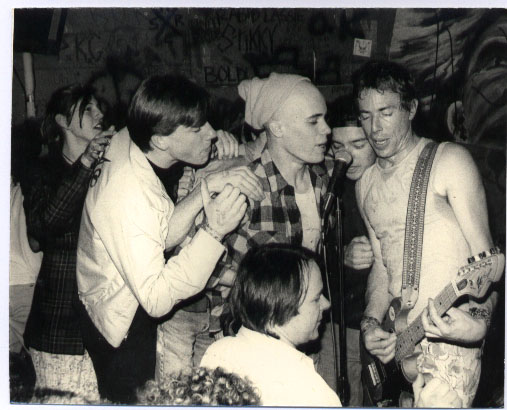
For about six months now Blogger wouldn't let me post pictures, and it's still trying to stop me doing so. But I think I may finally have found a way around its electronic obstinacy, and in trying to test my theory, I grabbed a photo at random and pasted it here. If it works - and that still remains to be seen - I guess I should say a little about the contents.

It was taken at Gilman Street, probably in late 1988 or early 1989, and almost certainly by the great Murray Bowles, who singlehandedly documented most of the early Gilman scene. Every weekend, virtually without fail, Murray would be there, the only guy in the pit with both a beard and glasses, looking more like a high school science teacher than a punk rock photographer. Between sets he'd hang out in the store or on the edge of the stage while people clustered around him waiting their turn to look through his box of photos from the previous weeks. If you saw one of your band, or your friend's band, or just one that might look cool in your fanzine or your scrapbook or the kitchen wall, it was yours for a quarter, which, Murray claimed, was exactly what it cost him to print them. Sometimes people would be so appreciative that they'd try to give him something extra, or maybe all they had was a dollar and they'd say, "Keep the change." But no, it always had to be a quarter, no more, no less.

I seldom get to Gilman these days, and I haven't seen Murray there in years - in fact the last time I saw him was on Avenue A in the East Village, outside Doc Holliday's, where he was playing a show with his country/bluegrass band, the Shitkickers. He plays the viola. I didn't ask, but I imagine in this digital age he doesn't sell a whole lot of photo prints anymore, though I could easily be wrong. He's still out there taking pictures all the time, though mostly of bands that I'm not familiar with, and tending more toward the thrash-metal side of things, which I believe Murray always had a soft spot for.

Anyway, the photo reproduced above contains a whole raft of Gilman luminaries. On the far left is Kamala, who you may have heard of in the context of her bands, Kamala and the Karnivores and the Gr'ups, among others, or the Screeching Weasel song, "Kamala's Too Nice." She was also a legendary tour booker back in the days before most people knew it was possible for unknown punk bands to tour the country (hence the line in the Screeching Weasel song, "Won't even ask her to book my band"), and set up the one and only Operation Ivy tour in 1988. Haven't seen her in years, but apparently she's now got a master's degree from Berkeley and is working in the field of transportation planning. Oh, and one last Kamala tidbit: when we were petitioning the City of Berkeley for permission to open Gilman Street, her dad, a very responsible and middle-class-looking fellow, came along with a bunch of us punks to make an impassioned speech to the City Council that just may have turned the tide.

Next to Kamala is Todd Wilder, who played drums in Stikky, a maniacally frantic and hilarious band who were big favorites at Gilman. They had an album out on Lookout, but it never came close to capturing what they were like in person. There are demo tapes which do a better job, but good luck finding them. Todd later went on to form a white reggae band that had some success, but that's the last I heard of him. He's leaning on the shoulders of Jesse Michaels, the singer and lyricist for Operation Ivy. Behind Jesse is Kaz, who was in a couple bands, neither of which I can remember the name of right now, and who was a constant presence at Gilman for several years. Crouching down in front is Marshall Stax, longtime KALX DJ, sometime Gilman sound man, and member of Blatz and Subincision. Marshall is also the only person I know who was at the last Beatles show (Candlestick Park, 1966) and the last Sex Pistols show (Winterland 1978).

The guy on the right, with the guitar, is me; unfortunately the other two Lookouts were obscured from view. It's impossible to tell from a photo, of course, but most likely we were singing "Big Green Monsters," a song co-written by Tre and Kain that always seemed to inspire the crowd to swarm up on stage and sing along with us. It was probably the goofiest song we did - amid a whole raft of über-serious political songs and attempts at punk anthems - but it was the one the people loved. It also helped me begin to understand that hooks pretty much always trump polemics.

03 September 2006

It's Not Easy Being Thick

Or so Kirk, long-suffering but lovable dolt, declares on tonight's episode of Coronation Street. He's going for the sympathy vote in his attempt to win back the affections of bolshie but also lovable strumpet Fiz, who had given him the boot for being too predictable and not romantic enough (yes, I know, we've all been there).

Kirk, wily grafter that he is (well, not really, but, he is, as he acknowledges, "bright enough to know I'm stupid"), counters by presenting Fiz with some allegedly original love poetry that turns out to have been cribbed from some Bread lyrics, and is busted when former entertainer Rita comes strolling into the Rovers singing that very tune (the very first time in 20 years Rita has spontaneously burst into song; what are the odds?) just as Fiz is daubing at the tears inspired by Kirk's newfound eloquence. Kirk's ready admission of guilt, his abject apology, and the above-cited plea for tolerance of the mentally handicapped do the trick, and he and Fiz live to canoodle another day.

Which is more than can be hoped for with most of the Street's star-crossed characters, but only serves to illustrate once more Oscar Wilde's dictum, "The good end happily, the bad unhappily; that is what fiction means." It's also why Coronation Street is miles ahead of EastEnders or any other show of its type, and one of the things I will miss most about England. In fact, I think one could make a case (and were it not so late at night, I might try this myself) for Coronation Street being so English that England itself sometimes seems but a pale simulacrum.*

*Yes, I know that's the second time I've used "simulacrum" in a week, and yes, I know that's no more acceptable than Wilde's using "tremulous" seven times in the first 100 pages of The Picture of Dorian Gray. But if you can find it in your heart to forgive him, please consider doing me the same courtesy, and I promise not to let it happen again.

The Sunday Papers

One of the things that originally attracted me to England and will make it difficult to leave is the quality (and quantity) of the newspapers. Yes, some of them are even more sensational and trashy equivalents of the New York Post, and yes, even the quality broadsheets indulge in levels of invective and tendentiousness that would never be tolerated in sober, august journals like the New York Times, but for me, at least, that's part of the appeal.

I used to have a neighbour who I'd see Sunday mornings staggering home under the weight of no less than 13 papers, everything from the weighty Times, Telegraph and Observer to the tawdry tittle-tattle of the Sun, Mirror, People, Star, and that acme of all scandal-mongering, the News Of The World (aka News Of The Screws). Although I must admit that the Star is offering some stiff competition, with cover stories about how "Wild Child" Peaches Geldof wants to join a cult of swinging lesbian porn stars."

On a slightly more serious note, Nirpal Dhaliwal socks it to Mayor Ken "K Diddy" Livingstone's race-pandering, Melanie Phillips sounds the alarm about homegrown Islamic terrorism (believe it or not, this woman used to write for the Guardian and look like one of Joan Baez's soul sisters from Carmel or Mill Valley, and Christopher Hitchens's grumpy brother inveighs against, well, just about everything. However, I just discovered that they want £2 to read Hitchens's column. Not worth it. Click the link to read his blog instead. And while you're at it, try Richard Littlejohn, who mines some of the same territory with less nuance, aplomb or inhibition.

Don't mean to overload you with right wing tosh this week, but the left wing version seems a bit thin on the ground for a change; even the normally reliably batty Mary Riddell has devoted this week's moanings to some pious blather about the Queen instead of her usual explanations about how we wouldn't have problems with those essentially well-meaning but misguided suicide bombers if only we'd make burqa-wearing mandatory and stopped being so horrible and patriarchal and white. Or if we'd just furnish all prospective Islamofascists with a complimentary subscriptions to the News Of The Screws...

Yuppie Playfest or Woodstock Redux?

Has anyone here actually ever been to the Burning Man festival? (You can try this link to the official Burning Man site if you want, but when I last checked, it was down; maybe too much sand in the hard drive, or the webmaster is still crawling around somewhere out there in the stoned out trackless wastes of Nevada and/or his mind. According to this account, some 43,000 people ponied up the $250 entrance fee, and this has been going - if not on quite so large or expensive a scale - for over 20 years now. Yet rack my brain as I might, I can't think of a single friend or acquaintance who will admit to having attended the post-hippie playfest in the desert.

Since I've always liked to believe that at least a few of my contemporaries and colleagues were of the - do they still call it this these days? - cutting edge persuasion, I find this a bit curious. Could it be that the crowd I run with is far more bourgeois than I imagined? Or is it more likely that that Burning Man is, as this account posits, "a nudie dopefest...in which project managers play at being free-love hippies for a week"?

My instincts have always gravitated toward the latter explanation, but I'm hesitant to reach any conclusion without actually seeing the event for myself, and I'm unlikely to do that unless a) I'm on the guestlist; and b) they move it out of the desert and relocate it next to a large body of water. In the meantime I'll try to reserve judgment, a task made considerably more difficult by the enthused ravings of the SF Chronicle's boho-yuppie correspondent, Mark Morford, who has been touting Burning Man for many years now, and who, as far as I can recall, has never, ever been right about anything.

Bye Bye Bobby Christgau

If Bruce Brugmann is to be believed, the new editor of the Village Voice has finally sacked Robert Christgau, its Jurassic music critic. While I'm not generally in favour of unemployment, especially the forced variety, Christgau had just about reached retirement age anyway. Still raving about long-in-the-tooth 80s noise rockers Sonic Youth being "the best band in the universe"), he had gone beyond the role of being the embarrassing would-be hip uncle to symbolizing much of what was wrong with the Voice. The first time I picked up the Voice, which would have been sometime in the mid-60s, I found it absolutely exhilarating; for the last couple decades, it's been New York's employer of last resort for bitter and/or delusional old lefties.

Which is probably why Brugmann finds it so threatening that the Voice finally shows signs of joining the 21st century: the same "alternative" media conglomerate that recently bought the Voice has, with its SF Weekly and East Bay Express titles, been making mincemeat of Brugmann's own wildlife refuge and petting zoo for superannuated radicals, the SF Bay Guardian.

London For The Last Time?

I've been back in the UK for a total of about 28 hours now, and it's brought up a conflicting welter of feelings, some comforting and comfortable like an old pair of slippers, and others melancholy and almost wrenching, the sort that come with endings and goodbyes.
I don't yet know with absolute certainty that I'll be leaving London, but everything seems to be tending that way. It feels much the way it did two summers ago, when I spent a month in my old house in the mountains, cleaning and clearing it, and preparing it to be sold. The more work I did on it, the nicer it felt to be there, and I could hardly look out one of its many windows without seeing an incredibly beautiful view that I could barely imagine not being able ever to see again.
And on my last day there, I walked up and down the road, looking at the mountains in the distance, at the trees and flowers I'd planted, at the personal history that lurked in ever corner of the land, and tried desperately to engrave the images so vividly on my mind that something of them would linger forever. I've caught myself doing that around London yesterday and today. Not around my apartment so much- as a box-shaped council flat, it's never been exactly a thing of exemplary beauty, but even in its plainness and drabness, there's a certain at-homeness that somehow I seldom noticed before - but definitely out in the streets. All my old complaints about London come flooding back quickly enough when the trains don't run or run badly, or when the drunks come screaming down Charing Cross Road smashing bottles and sluggish pedestrians as they stumble, but they're minor irritants, really, like mosquitoes in the forest or sand flies at the beach.
And of course I'm only selling my apartment; it's not as though I'm giving up the right ever to return to London. But it won't be the same, and if I go, my chances of ever living here on a fulltime basis again are slim. I'm sure I've said it here many times before, but I have a very hard time with changes and goodbyes. It makes me wonder: if I have such difficulty leaving a city, how will I cope with it when it's time to leave this life altogether? The answer, I think, is to treat all these little goodbyes as dress rehearsals for the big one. Hopefully I'll have enough time and practice to get better at it before that comes around.