09 May 2007

The Trials Of The Aristocracy

The years haven't been kind to Mr. and Mrs. Sting, all that tantric sex notwithstanding, at least judging from this photo. But then can you blame the poor dears for looking a little careworn, given the terrible problems they've had to endure with the household staff. Why, it was bad enough having to ferry their chef back and forth from Salisbury to London whenever Mrs. Stink, er, Sting, felt the need of a sandwich, but then what should the ungrateful wench (that's the chef, not Mrs. Sti... never mind) do but go and fall pregnant? The nerve of the woman, and with the Stinks then stuck having to muddle through with a skeleton staff of two nannies, two housekeepers and just one butler!

Naturally the woman had to be sacked, and now adding insult to injury, the Stinks have been found guilty of unfair labor practices by some Defargian employment tribunal, and may have to pay out hundreds of thousands in compensation to the recalcitrant and obstreperous chef. It's enough to make you wonder why such good and gracious members of the nobility continue to endure the trials and tribulations of living in Bolshevik Britain when all they're likely to receive in return is this sort of abuse.

"These Are Graduate Students? They're Idiots. They Can't Even Write."

So says Ben Chavis, principal of an Oakland charter school that's one of the only educational institutions in that sad, benighted city to show itself capable of some actual educating. Apparently, however, this has been accomplished with little regard for prevailing educational theories and liberal niceties.

Naturally, there's agitation to get rid of him, led by a delegation of what at first glance appear to be dingbats from the ivory tower up the road, the expensive private Mills College, where a professor is up in arms because her delicate charges weren't treated with sufficient sensitivity. Chavis sneers that the letters of complaint he received didn't even contain correct grammar, and I'd be inclined to back him up on that one: I frequently encounter grad students, even Ph.D. candidates, who can't write or spell at what I would consider high school level.

The crux of the complaint is that Chavis uses crude and racially insensitive language in dealing with his students. We're talking of course about students in an educational system that has for decades been producing little more than prison fodder, and who are growing up in a town where violent crime is so common as to barely merit a notice in the local paper unless multiple corpses are involved. I'm inclined to think that if Chavis' methods are working as well as they appear to be, Oakland needs to look into hiring a few drill sergeants to make sure all the kids in the Oakland School District get their fair share of being sworn at.

Some Pricey Guitar Strings

$16,800 for a collection of guitar strings? Oh, but they're Jerry's strings, as in Jerry Garcia, the drug-addicted guitar wizard and paterfamilias of legendary hippie band, the Grateful Dead. Jerry's name proved sufficient to inflate the value of two old guitars and a bunch of junk to $1.1 million, which would only seem over the top or downright loony if you'd never met any hardcore Deadheads. Having spent a number of my formative years in San Francisco, Berkeley, Marin and Mendocino, however, I've had an extensive exposure to Jerry's Kids.

Some of them are essentially good-natured, and I've even met a few who had the ability to laugh at themselves and their obsession, but there were others - like the one whose face turned bright red and who was literally jumping up and down with rage because I'd mentioned in a Lookout article that Jerry was looking a bit, well, obese - who bordered on the feral and/or demented. After the Dead's demise, some of these more unhinged individuals, no longer having a band to follow around, settled down in places like Garberville and Arcata, where they may still be infesting public space with pleas for spare change and impromptu stoned-out jamfests.

I'm assuming they weren't the ones forking over thousands of dollars for empty speaker boxes and similar miscellany, unless the spare-changing business is doing better than I'd imagined. Seriously, I've met all sorts of Deadheads who've gone on to become lawyers, professors, financial managers, even doctors and shrinks, and anyway, given my own somewhat unusual and obscure musical tastes, who am I to judge?

Anyway, while in the past I've gotten quite a bit of mileage out of ridiculing the Dead and their camp followers, I've had to have a bit of a rethink, to the point where a few songs from the band's country-ish era (American Beauty and Workingman's Dead) nestle happily amid the pop-punk, doowop, big band and Hank Williams in my daily shuffle. I don't think I'll be accumulating any of their memorabilia, though, since for the last few years I've been all about trying to get rid of junk rather than collecting more of it.

Giving me one more reason to kick myself when Green Day/Op Ivy/Lookout Records souvenirs start bringing in the big bucks, but hey, you're looking at the guy who once had a near-complete collection of 1954-56 baseball cards, all vanished into the dumpster or some even less salubrious destination when I "outgrew" that sort of thing. But hey, if it weren't for clowns like me throwing away all the valuable stuff, it would never have become rare enough to be valuable. So I think you rich collector geeks owe us a percentage.

07 May 2007

Drive-By Sydney

It was a rare day in Sydney when I didn't stop by for a coffee at Gloria Jean's on Oxford Street. Gloria Jean's is a nationwide chain in Australia, sort of like the homegrown alternative to Starbucks (only with better and cheaper coffee and a more pleasant ambiance and color scheme), but the branch on Oxford Street, located near the ass end of the gay ghetto, was one of a kind. It stayed open late, sometimes even all night during special occasions, and the later it got, the more, er, colorful the crowd got.

Sometimes a little too colorful, especially once the club next door opened its doors for the evening. It attracted a rather macho, almost thuggish element, and the patrons would occupy the sidewalk in such a peremptory and confrontational manner that it sometimes made more sense to walk out into the street to get around them. Several points along Oxford Street have seen similar developments, to the point where many of the street's traditional gay patrons no longer like to come up there on weekend nights.

It's not just the sidewalks, either; Oxford Street itself is lined with hoons (what the English might call boy racers, what the Americans might call, I don't know, assholes with muscles cars) revving their engines and squealing their tires in a testosterone-fueled cacophony of bad vibes. The police do nothing; in fact they're seldom even seen along the strip. Australia seems to have adopted the laissez-faire policing tactics that produced so much misery in New York during the 1970s and 80s, and which are now responsible for soaring crime rates in London.

And so it was probably only a matter of time before I'd be scanning the Sydney Morning-Herald, spot a photo of my old hangout, only to see that it accompanied a story of a drive-by shooting that injured three people. As much as I miss the fabulous weather, scenery, beaches, food and atmosphere of Sydney, I can do without the steadily increasing air of menace that seemed to be settling over its streets. Indeed, I feel considerably safer here in New York, and who could have imagined things would ever come to that?

Dellums Takes Charge

Doddering Ron Dinkins, er, I mean Dellums, is off to a blinding start when it comes to attacking Oakland's myriad problems. After a couple months-long disappearing act, he's now surfaced with a million-dollar makeover on what he apparently considers the most crucial of them: his office. Oh yeah, plus a pay raise for himself and a new driver and bodyguard to accompany him through the streets of his fair city. Oh, and where's he coming up with the money in that perennially broke city? Half of it's being lopped off the budget of one of the new schools launched during Jerry Brown's tenure. Let's see: educating children or pay raise and chauffeured limo for the mayor, which is more important? Don't say I didn't warn you.

Urban Renewal

"Big Plans For Making Downtown Berkeley A Cultural Hub," says the Chronicle, which has been running a similarly headlined story semi-annually for at least 25 years now. You might question why a town with a distinguished history as "The Athens of the West," home to one of the world's great universities, and located smack in the middle of what is alleged to be a major American cosmopolis, would need to be "planning" to become a cultural hub? Shouldn't it be one by default?

Berkeley is forever coming up with plans to "restore" or "revive" or "beautify" downtown; its last stroke of genius was to cut down all the trees and replace them with saplings which, if they're lucky enough to survive 20 years of being backed into cars and being broken off by mentally deranged ferals, just might make downtown look as pleasantly shady as it was before they cut down all the old trees. That bit of "beautification" cost the city over a million bucks (they got some new paving and park benches out of it too, I think), and guess what: downtown is just as unpleasant, unlovely as ever. Vacant storefronts abound, and begging and mugging remain major industries (after 9 or 10 pm, the only ones).

What Berkeley's planners seem never to comprehend is that you can't design or plan or build your way out of a social problem. Nearly all of downtown's problems can be laid at the door of Berkeley's willingness - eagerness, even - to tolerate levels of criminal and antisocial behavior that will turn any neighborhood, no matter how nicely built or designed into an instant slum.

I'm reminded of that by The Devil's Playground: A Century Of Pleasure And Profit In Times Square, which recounts the rise, fall, and rebirth of America's crossroads. When Times Square was it its worst in the 70s and 80s, city officials private foundations argued and agonized over a plethora of urban renewal programs, none of which were to do any good at all until the city finally, under Mayor Giuliani, did what a police commander had pleaded for back in the 1980s: "Go back to the old style of police work, when men on the beat could enforce standards of public decency and order."

The author, James Traub, goes on to suggest that the degree of public and private expenditure that finally went into remaking Times Square may have been unnecessary. Based on what has happened in other neighborhoods which flourished of their own accord once Giuliani made the city livable again, I'm inclined to agree. Make downtown Berkeley a pleasant and inviting place by removing or at least restraining the deranged, demented and hostile individuals who currently dominate its streets, and a similar result would obtain. Or, alternatively, spend millions of tax dollars creating yet another "civic/cultural hub," aka bum magnet.

05 May 2007

Boomer Bashing

Crowded as the bandwagon may be getting, it's still difficult to resist jumping aboard. I remember reading years ago how the baby boomers would become even more unpopular than they were once the time neared to start cashing in on Social Security and Medicare. Sure enough, a new Era Of Bad Feeling is overtaking the younger taxpaying generations just about on schedule.

A better than average sample of the boomer-bashing genre can be found in last week's SF Weekly article by Martin Kuz, combining hard facts and invective into a delightful cocktail of abuse. It does go on a bit, at least compared with Frank Portman's succinct dismissal of "The Most Annoying Generation," later acronymized as TMAG, but gets the job done nonetheless. It had me riled up, even though I've been slagging off the boomers since the mid-1980s and wouldn't have thought there was a whole lot of opprobrium to be heaped on them that I hadn't already taken a stab at heaping.

Then there's the oft-remarked upon blogsite DieBoomerDie, worth a visit if only for the list of links to other boomer-related sites, most but not all hostile. You begin to get the impression that the generation born between 1946 and 1964, whether or not it's the most annoying in history, is certainly the most hated.

It's easy to understand why, too, at least among younger people. After all, they're the ones who've had to listen to the boomers' sanctimonious prattle while growing up in the social, political and cultural wreckage left by a selfish and self-obsessed cohort of aging acidheads. But what explains my antipathy toward what is, like it or not, my own generation?

That's an especially pertinent question considering how avidly I once embraced the worst excesses of the baby boomers: massive drug abuse, a distorted, hugely magnified sense of self-importance, opposition to all authority, doing whatever I could, albeit from a rather lazy and perspective, to undermine the fundamental structures of society. Looking at it in that light, I suppose my response today is at least partially one of guilt, or, thinking in more constructive terms, trying to undo a bit of the harm I participated in.

And maybe I'm deluding myself, but my impression that the generations that have followed in the wake of the boomers are, on average, more intelligent - even if only in the sense of being willing to admit that they don't know everything - and responsible (well, apart from those who've been encouraged/enabled to live rent-free in Mom or Dad's house ad infinitum, often because it's the only way M or D can obtain a captive audience for their boring stories about how we stopped the Vietnam War and invented sex and brought civil rights into existence while all the while being blitzed out of our minds on powerful psychedelics that of course the younger generation shouldn't take because they aren't, you know, as together as we were, blah blah blah.

Geez, I'm getting worked up about it all over, which is not a good sign. Could I be becoming as obsessed with rampant boomerism as the rest of my generation, only from a negative rather than a fawningly positive standpoint? If so, I'd better leave it there, thought not without a final word of warning to any younger readers who might still be tempted to romanticize the 60s: don't. They sucked. Bad fashions, bad hair, smelly, obnoxious people rolling around in the mud and listening to music rendered palatable only by staggering doses of mind-distorting drugs, and constantly ranting like homeless derelicts about how they were going to save the world and abolish money and build spaceships to colonize new planets that would be just like Earth only better because, you know, everyone would be high and enlightened and love one another.

Trust me, you're much better off living in today's world, boomer wreckage and all. And if you can only muster up enough votes to shut down Medicare and Social Security, we'll start dying off in droves and finally leave you alone. Or, less drastically, raise the retirement age to at least 70 or 75, and maybe we'll be too busy working to do quite so much yapping.

French Fries Back On The Menu?

If the results go as expected in tomorrow's election, France may end its decades-long exile in political la-la land, and the French people will embark on the sort of rude awakening that befell Britain under Margaret Thatcher. "We have two days to liquidate the legacy of May 1968," says Nicolas Sarkozy, and you get the feeling he means it.

The Guardian attempts, predictably enough, to brand him as a radical right-winger and/or neoconservative, but Sarkozy would fit comfortably into America's Democratic Party, slightly to the left of Hillary Clinton, perhaps, and a bit to the right of Barack Obama. Which, under the standards by which France has been governed since les annees soixantes, makes him the slightly wet counterpart to Attila the Hun.

Please don't take this as typical American surrender-monkey bashing; any disdain I might have for the French was acquired during the years I lived in England, where they have been doing this sort of thing for centuries, and have understandably gotten rather good at it. But like many Americans and Brits (though the latter would seldom admit it), I also have a lot of liking and admiration for France and the French. I think of them in the same way many of them think of us: lovely country, lovely people, shame about the government.

I don't even have that many quarrels with their social policies. I think it's great if people only have to work 35 hours a week, if many people don't have to work at all, that there's cradle-to-grave security, that any group of workers can, if mildly aggrieved, shut down the country without fear of consequences. "Nice work if you can get it," as Ira Gershwin might have put it, but there's only so long a country can sustain itself on economic principles so abstract and imaginary that they call to mind the common joke among workers in the old Soviet Union: "We pretend to work and they pretend to pay us."

France needs another Socialist government, even if it's the watered-down socialism of Ségolène Royal, about as much as it needs another variety of smelly cheese. Ms. Royal, who comes across like a slightly overwrought cross between Nancy Pelosi and Oprah Winfrey, has been trafficking largely in emotion, sentiment, and symbolism. In other words, she'd be right at home on the Berkeley City Council, but presiding over 60 million Frenchmen and the world's sixth largest economy might be a bit beyond her grasp.

The worst - and I think most unfair - charge leveled against Sarkozy is that he is a racist, but there is little evidence of this. Himself the son of an immigrant, he has actively sought to improve the lot of immigrants, supporting affirmative action, the creation of the Council of the Muslim Faith, and appointing the country's first prefect to be both foreign born and Muslim. If followed through on, his promise to crack down on the feral populations of the banlieue, far from being an attack on Arabs and blacks in general, will actually benefit the majority now being held hostage by the criminal gangs who control the streets.

Similar charges were leveled at Rudy Giuliani during his tenure as New York mayor, yet by slashing New York's murder rate to a quarter of what it had been, Giuliani saved thousands of lives, the majority of them black and brown. Neither in New York or Paris do the thugs, vocal and visible as they might be, represent the dominant ethos of the minority community; those politicians who pander for votes by letting criminals run free are the worst sort of racists. Women residents of the banlieue in particular would benefit from Sarkozy's promise to clear out the racaille, and a fair number of them support him for precisely this reason, as recounted in this BBC story.

If Sarko wins, expect relations between France and the USA to warm considerably. It's not likely he'll be cozying up too closely to President Bush, who is increasingly seen not just in France but around the world as un canard more dead than lame, but Sarkozy is that rare brand of European politician who finds much to admire about America and Americans. If he manages to pull off what he proposes to do, the admiration is likely to become mutual.


04 May 2007

More Notes From My Old Backyard

When I think of the punk years, particularly 1977, I always think of one particular spot, just at the point where the elevated Westway diverges from Harrow Road and pursues the line of the Hammersmith and City tube tracks to Westbourne Park Station. From the end of 1976, one of the stanchions holding up the Westway was emblazoned with large graffiti which said simply, “THE CLASH.” When first sprayed the graffiti laid a psychic boundary marker for the group – This was their manor, this was how they saw London.
Jon Savage – Punk London
I've already had my say on the revolutionary mythology surrounding the Clash, created in equal parts by the band itself and by starry-eyed romanticists so eager to relive the 1960s that they were willing to glide over a whole raft of inconvenient facts. Now here comes Bernie Rhodes, the Clash's manager during much of their career, weighing in with his opinion: "They've turned Joe [Strummer] into a hippie because they wanted another John Lennon."

That nugget was massively overshadowed, however, by his opining loudly to a crowd of underground media luvvies and punk exhumers, that "If you want to sort out crime in London, sort out the niggers." Not the sort of thing you'd expect to hear in polite company these days, let alone in a room full of Strummerian acolytes, and Rhodes was quickly bundled off stage, the balance of his remarks drowned out by a Clash film clip (look here for another account).

Was Rhodes simply off his face and having a Mel Gibson moment? Possibly. Right thinkers around town were quick to denounce his remarks as racist, and you can't deny that his fit that bill. But replace the N-word with "blacks" or "Afro-Caribbeans" and you wouldn't be saying anything that many Londoners - some of them black themselves - haven't been saying for some time. It's a matter of public record that young black men commit a wildly disproportionate amount of London's crime.

Pointing that out, however, is rather different from advising that "the niggers" be "sorted out." In addition to the obvious offensiveness of the language, it makes no attempt to differentiate between the masses of black people who live ordinary, decent lives and the significant minority of black people who are responsible for a lot of crime. What makes things all the more curious is that Rhodes also managed the 2 Tone ska band, The Specials, who championed black music and had two black members. Not exactly the CV of a racist, but maybe his views have changed since then.

Whatever the reasons for Rhodes' impolitic outburst, I doubt he'll be getting a chance to explain himself; something tells me dinner and speaking engagements will be thin on the ground for a long time to come. And without suggesting that Rhodes' views in any way reflect the thinking of the Clash members themselves, it might be worth bearing in mind that this is the man who played a large role in creating and orchestrating the image they displayed to the world.

03 May 2007

Laytonville And The Lorax

I noticed today that someone had wound up on my site though googling "Laytonville Lorax," which sent me looking back through the collection of articles that I wrote for the Anderson Valley Advertiser back in the late 80s and early 90s. The Advertiser at that time was edited and published by the irascible and - to put it mildly - controversial Bruce Anderson (no relation to the valley of the same name, but boy, did they deserve each other), and who for about 20 years devoted himself to annoying and outraging the local hippies and rednecks with his Menckenesque attacks on the pomposity, hypocrisy and parochialism that he felt (correctly for the most part) ruled local politics and culture.

I came to Bruce's attention through my efforts to do much the same thing with my own magazine, Lookout. He started reprinting many of my Lookout articles, and eventually I began submitting new ones directly to the Advertiser, becoming in effect its Laytonville correspondent. I've decided, after some hesitation, to reprint one here. You'll no doubt see why I was hesitant; it makes me sound like some 16 year old anarchist (I believe I was in my early 40s at the time) rather than the careful, compassionate, thoughtful and reasoned observer you no doubt know me as today.

I'm also reluctant to print it because the piece paints its chief villain, local logging baron Bill Bailey, in more unflattering terms than he deserves. Yes, he was wacky to try and ban The Lorax, and yes, I'm sure I could still find quite a few things to disagree with him about, but in the years following the publication of this story, I came to respect the man a good deal more, not least for his philanthropic efforts, but also for his character, one aspect of which was a good old-fashioned Western-style cussedness that often masked a heart much bigger than people gave him credit for. Okay, enough disclaimers, here's the story, and just try to remember: we were all a lot younger in those days.

(P.S. It's long, so if you're not interested in the ancient history of small town environmental conflicts, feel free to give it a miss.)

Sometimes I just get so tired. There have got to more interesting and useful things to do with a Thursday night than drag oneself into Laytonville to do battle with a handful of closet nazis who feel threatened by the idea that our schools might somehow produce a generation less ignorant than themselves.

Sure, the national media had a field day ridiculing the northern California hick town goobers who were out to ban Dr. Seuss, and I suppose readers accustomed to my not inconsiderable bent for sarcasm and satire might expect the same from me. But I'm just not in the mood for it.

Even though I've gotten a lot of mileage out of making fun of Laytonville over the years, I happen to like this town and I also happen to know that it's populated by many intelligent, caring people. That's why I resent it when some two-bit fascist twerp like Bill Bailey can turn the name Laytonville into a synonym for ignorance, prejudice, and know-nothing bigotry. Not just in Mendocino County — he's already been doing that for years — but across the entire United States.


Mr. Bailey has gotten it into his head that the ability to acquire large amounts of money is somehow indicative of intelligence, and that since he is the richest man in town, ipso facto he must also be the smartest. So it doesn't seem at all out of the ordinary to him that people like himself are best qualified to decide what children should be thinking about, as well as what they should be prevented from thinking about.


An unarmed man caught in a battle of wits usually goes looking for a club, and Bailey has a sizable one, namely a bankroll that would choke a whole passel of loraxes. If you or I don't like some idea that is going about, our only recourse is to come up with a better idea and then be able to convince others that it’s a better idea. Bailey, whose intellectual larder is as barren as his moneybags are full, doesn’t have that option.


If he thinks The Lorax gives children a mistaken impression about the value of conservation and the destructiveness of greed, let him present the schools with a book that will give an opposing viewpoint. Let him show us an interesting, well-written children's book that explains why it’s a good thing to cut down what's left of our forests, to destroy our streams and fisheries, to alter our climate, to leave behind a monumental legacy of toxic waste and pollution so that Mr. Bailey and a handful of corporate bigshots like himself can make a few more million bucks. If Bailey doesn't like The Lorax, it's because he sees himself in it, and what drives him all the more nuts is that with all his money, he can't pay an author enough to write a book that will make him look good.


The millions of dollars he has made selling implements of destruction to forest-rapers around the globe will never be able to buy him respectability, but they have bought him two seats on the Laytonville school board. That, combined with the vote of good ol’ gal Judy Geiger gives Big Bill a majority vote, and an awful lot of power over what does or doesn't go into the minds of Laytonville school children.


Thanks to the efforts of Big Bill and a few similarly minded yahoos, Laytonville has long been notorious around Mendocino County for being a hotbed of intolerance and carefully cultivated stupidity, and now that reputation has spread across the country and around the world. But the TV news people and the reporter from People magazine who showed up for the Laytonville school board meeting last week must have been severely disappointed if they were expecting a hall full of Bailey-style peanutbrains.


What they found instead was small town American democracy at its finest, a couple hundred outraged citizens of all ages there to tell their elected officials in no uncertain terms: leave our kids alone. Yes, there were a few professional serfs ready to testify that whatever Massa Bailey said was just fine with them, but a good 80 or 90 per cent of the crowd was there to speak out on behalf of freedom, justice, and the American way. And I say that without the slightest trace of sarcasm, because while there are many things most vile and heinous done under the banner of Americanism, there is also in this country a tradition of free thought and inquiry that even the most brutal cynic must acknowledge.


Which is why Bill Bailey, despite his flag waving and pandering to the most reactionary sort of patriotism, is fundamentally un-American. He doesn't believe that people should be free to seek out the truth; he believes that the powerful should determine for the people what the truth should be, and that further discussion is not only unnecessary, but also downright subversive. Yes, taking one book off the second grade reading list in one small town elementary school is a fairly minor step in the direction of state censorship, but the fact that Bill Bailey wants to take any steps at all in that direction makes any of his educational views highly suspect.


Those views would be of little note in Laytonville, where he is widely regarded as a laughingstock, if he hadn't managed to put his hired hands on the school board during the past summer's election. Their victory was largely due to their stand on the new high school building site, not to their affiliation with the Bailey slate, but huge infusions of what Bailey lovingly calls "timber dollars" couldn't have hurt.


Ironically, one of Bailey's new lackeys on the school board is Art Harwood, the scion (the "crown prince," in Judy Bari's words) of Laytonville logging's long-time first family. But, as so often happens out here on the frontier, new money has overtaken old, and young Harwood now has to do the bidding of Mr. Bill. Mike Wilwand, Bailey's other representative on the board, should have no illusions of independence; his weekly paycheck comes directly from Bailey Enterprises Amalgamated, Inc.


The swing vote on the five-member board belongs to Judy Geiger, who while she hails from another of Laytonville's principal clans, gets along with many of the newcomers (they used to be called hippies in polite society and a variety of unprintable names in most of Laytonville) who have moved to the area in the last twenty years. But when push comes to shove, she still sides with the old-timers, and that's why, regardless of how many citizens turned out to defend The Lorax, the fix was already in. The votes were in Bill Bailey's pocket, and The Lorax was one dead duck.


At least that's the way it looked for most of the meeting. There was an hour of speechmaking allotted to the public, some of it quite eloquent. A representative from the Long Valley Teachers Association attacked "the demagoguery of a few wealthy businessmen," a plain-spoken logger gestured toward his four children who "eat and sleep in a house paid for with timber dollars," but who was nonetheless opposed to the sort of censorship being proposed by the Bailey forces. Still another declared, "I'm not so much afraid of ideas as I am of taking away the freedom to discuss ideas."


About ten speakers had denounced the book-banning proposal before one rose to insist, "There are many in this community who find this book offensive." Very few of them, however, bothered to show up for the meeting. For that matter, Bill Bailey himself, the author of the entire mess, was nowhere to be seen. It was a prudent decision on his part, since given the temperament of the crowd, his ego would have suffered the emotional equivalent of a big fat cream pie smack in the kisser. One of the evening's biggest laughs, in fact, came when a speaker alluded to "Bailey's coat of arms," the ludicrous symbol Big Bill had commissioned in an attempt to glorify a logging industry now engaged in a Final Solution to the Northern California Tree Problem.


(By the way, those of you interested in supporting Mr. Bailey's efforts should pick up his fall catalog, which offers you a chance to purchase about 100 different items emblazoned with the "Woodsman's Coat Of Arms," including some hewn out of 14k gold at several hundred bucks a pop, and others adorned with genuine spotted owl tail feathers mounted on a plaque of guaranteed old growth redwood and coated lightly with a petroleum-based dioxin product for preservative purposes. All proceeds go to benefit the Woodsman's Philanthropic Society to Buy Bill Bailey Another $100,000 Sports Car.)


Someone read into the record Bailey's pronouncement that, "The Lorax...criminalizes a very legitimate and needed industry, implies that we lack concern, ignores that we are planting trees, that we give a damn about creeks and erosions, and that we are looking for sustained yield." This didn't get such a big laugh, probably because the truth of the matter is so tragic. If the logging industry has been criminalized, it was not by Dr. Seuss, but by the criminals who now control it, corporations like Louisiana Pacific and Georgia Pacific and Maxxam, and, sadly, our own Harwood.


Planting trees? Sustained yield? Even the timber industry-controlled Department of Forestry acknowledges that trees are being cut down in Mendocino County twice as fast as they are being replaced. Give a damn about creeks and erosion? Don't make me sick. A seven year-old child, whether or not his mind has been contaminated by The Lorax, can walk anywhere in Mendocino County and see the contempt big timber has for our waterways. Come look at the land where I live, where I've been working for eight years to clear out the mess they made of my stream.


But through all the testimony, through all the pleas for tolerance and open-mindedness, the three Bailey stooges on the board sat apparently unmoved. Every once in a while Geiger would roll her eyes disdainfully, most notably so when board president Bill Webster argued that The Lorax expresses "...a valid point of view — it won't harm kids to see that." Harwood, whom I had originally mistaken for the high school student representative, successfully kept a look of mock seriousness plastered across his face most of the time, but every so often you detected a trace of a smirk in his unnaturally youthful countenance, the kind of smirk that says, "Yeah, yeah, but I don't care because my daddy has more money than yours."


Only Wilwand appeared to be giving any consideration at all to the sentiments being expressed by the overwhelming majority, and as the evening went on, he looked increasingly troubled. As he spoke, he steered a tortuous path through his own circumlocutions, trying with a tired desperation to prove that even though he was going to vote for yanking The Lorax, he was doing it to support academic freedom, not to oppose it. His argument was of course preposterous and he knew it; the pain of having to utter such patent tomfoolery showed clearly in his strained features. A sensitive and intelligent man, Wilwand could not have felt entirely comfortable about what he was doing, but on the other hand, it wouldn't be too much fun to show up for work tomorrow morning and have Boss Bailey saying, "What's this crap I hear about your conscience?"


Harwood and Geiger appeared untroubled by such considerations, and plowed ahead with their game plan, apparently arranged in a pre-meeting caucus, to present the anti-Lorax move as a blow for academic freedom. "There's a better way to handle this book," said Harwood, claiming that second grade was "not an appropriate level" for children to be studying it. He suggested that it be moved to the seventh grade, a proposal that strained the credulity of many present, although one wit muttered something about Laytonville kids having to be in seventh grade before they could read at a second grade level.


"The mandated reading list should be obliterated," said Geiger flatly, her choice of words perhaps unconsciously revealing her pro-logging bias. There was a certain logical appeal to this tack, even I had to admit; why should a teacher have his or her reading lists established by some committee? But as one Laytonville Elementary School teacher explained to me afterward, "If we didn't have a list, every time I assigned a book like The Lorax, I'd have parents coming to me saying, 'Why that book? Why couldn't you have picked one of these less controversial books?'"


At any rate, despite the attempts of Harwood, Geiger, and Wilwand to change the focus of discussion from The Lorax to the whole concept of required reading lists, it was only The Lorax that was being voted on, and that's where the anti-Seussian cabal was finally tripped up. The fifth board member, Dan K'vaka, who had already spoken firmly in favor of keeping the book, made a suggestion that the matter be shelved for the time being while the Superintendent prepared a recommendation on whether the required reading list should be abolished and replaced with a suggested reading list.


Geiger and Harwood couldn't very well reject K'vaka's proposal without admitting that the business about required reading lists was merely a smokescreen, and Wilwand looked positively relieved to be offered a way out of the dilemma. Before the audience realized what had happened, the board voted unanimously to leave The Lorax alone until such time as Superintendent Buckley could report back to them, and the meeting recessed.


It was a small victory, though; Bailey still has the votes, and if he insists strongly enough, he can probably get any old lunkheaded book-burning proposition railroaded through. And while book-burning may seem too strong a term to apply to what is really a fairly mild bit of censorship, there is, as Ray Bradbury said in his coda to Fahrenheit 451, "...more than one way to burn a book." To question the validity of ideas is the essence of freedom, but to attack the very existence of ideas is the underpinning of fascism, as well as being the intellectual equivalent of hauling out the kerosene and the matches.


This whole sorry chapter allegedly started when Bill Bailey's own son came home from school after reading The Lorax and confronted dear papa with the reality of what he was doing for a living, and with the ultimate consequences of the way of life he propounds. A wise man learns from his children, while a foolish man cannot imagine that one so young and innocent could have anything to teach him. But it takes a truly vicious man to attempt to deny even the possibility of wisdom to those younger or weaker than himself.


Fortunately the people of Laytonville came forth to demonstrate that Bill Bailey doesn't speak for them. The fact that a town is populated by sensible, freedom-loving individuals might not make as good media copy as the image of a howling lynch mob prepared to burn pinko children's book writers at the stake, but if Laytonville is going to have a national reputation, I'd much prefer it to be for the former reason. Personally, I'd like to see Bill Bailey take out one of his full-page newspaper ads to apologize to our community for the disgrace he's brought on us, but I suppose that will happen about the time his own private hell, where he seems to want the rest of us to dwell, freezes over.

Until that happens, unfortunately, I'm afraid there will be those who will continue to believe that, as one woman stated that night, "Laytonville really is the dope capital of the world."

02 May 2007

On A High Rise Estate

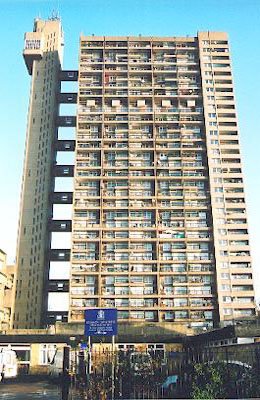
For years the view from my bedroom window in London was dominated by the unlovely behemoth to your left. In a city replete with gigantic architectural blunders, the Trellick Tower was perhaps the most notorious of all. It was built between 1968 and 1972, the same period during which hundreds, perhaps thousands, of Victorian terrace houses were leveled by the Council to make room for what was optimistically called "social housing."

"Antisocial housing" might have been a more apt description of what the tabloids took to calling the "Tower of Terror." Perhaps architect Ernö Goldfinger was too concerned with creating a legacy or adhering to the principles of modernist/brutalist architecture to pay attention to the pragmatics of creating a pleasant, livable environment; almost immediately after it was opened for occupancy, things started going wrong.

Fixtures fell off or were broken off by vandals and never replaced; windows and door glass were kicked in and similarly left like so many festering sores. It was not unheard of for chunks of concrete to break lose and come tumbling down when and where you least expected it. Many of the problems were of the kind that are commonly found in public housing estates (projects, as the Americans say), but the Trellick's difficulties were exacerbated by its design, which must have looked fabulous on paper, but in reality left vast stretches of the building unmonitored and unprotected, virtually guaranteeing that they would be taken over by the feral elements of the population.

I attended a late night after-the-pub party there in 1976; even in my rather inebriated state, I was shocked by the shabby and menacing aspect of what was almost a brand new building. Most of the corridor lights were missing - had been smashed, to be more precise - and none of the lifts were operating, leaving us to walk up 19 flights of urine-stained stairs. "You don't want to trust the lifts even when they are working," our host advised us. "The kids jam them somehow so they can hang out in them, and you never know when or where they're going to stop. You could be stuck for hours. Days, even, the way things work around here."

One thing that could be said in favor of the Trellick Tower was the view it afforded its residents. Even on the 19th floor you could see right across London. Those who lived in the near and not-so-near vicinity weren't so fortunate: all they got from the Trellick's commanding stature was an eyesore blotting out the horizon.

Granted, there were those (apart from the architect) who claimed to see a certain beauty in its muscular concrete lines, but most of us saw only an instant slum, its squalor and degradation raised like a banner for British decline and failure. It wasn't until years later, when I visited Eastern Europe and saw similar tower blocks that I understood how little, ideologically and esthetically speaking, had separated Britain's socialists from their counterparts in the Soviet bloc. In both cases, function ran roughshod over form, and the human beings who had to live in these brave new enclosures were mere ciphers in some apparatchik's Grand Design.

In the 90s someone got the bright idea of planting a row of fast-growing evergreens behind my building, and within a few years, they'd blotted the Trellick Tower from view, along with deadening the perennial noise from the Westway, the Underground, and the Paddington railway line. Every so often people on the upper floors would complain that the trees had grown too high, the tops would be lopped off, and part of the Trellick would slide ineluctably into view, but within a year or two we'd be back to the illusion of living in a forest glen (apart from the junkies and the prostitutes who'd come sidling in to take advantage of the privacy it afforded). We even had a fox who took up residence in the hedgerow and could be seen in the wee hours, a glazed look in his eyes as he darted between the rubbish bins at opposite ends.

And though the Trellick Tower and its slightly more diminutive cousins still ruled the skyline looking north to the hardbitten precincts of Queens Park and Brent, it gradually receded from my consciousness. On our side of the Westway, few buildings were more than three stories high, the majority of them dating back to the mid to late 19th century. When I'd first come to the area many were in a state of advanced decrepitude, abandoned or occupied by squatters, but they've since been renovated and re-occupied by the burgeoning class of media and professional people flocking to what suddenly became the very trendy Notting Hill.

Many of these houses - which in the 70s were slated for demolition by the same authorities who gave us monstrosities like the Trellick - now sell for in excess of £1 million ($2 million). Unfortunately, my house - flat, I should say - was not among them. Here and there, interspersed like so many broken teeth in an otherwise presentable jaw, the Council had had its way, replacing Victorian terraces with council estates that, if not as spectacularly as the Trellick, degenerated just as quickly into yellow and red brick slums.

Our building opened in 1974; within a couple years the elaborate intercom/door entry system had been demolished and the doors themselves ripped off the hinges to facilitate entry for clients of the ubiquitous drug dealers. I first arrived there in 1975, and already the institutional green paint was chipping from the walls and the corridors reeked with what Orwell's 1984 described as "the usual boiled cabbage smell."

The years were kind to our little block of 104 flats: following Thatcher's right-t0-buy program, about half the flats went into private ownership, some of the worst drug dealers and criminals were evicted or imprisoned, and eventually we became a tenant-run cooperative, which succeeded for the most part in keeping the doors on and crime limited to the usual noise complaints and petty vandalism. Even the boiled cabbage smell receded, overpowered by the curries of the increasingly numerous Asian residents.

We were becoming a normal building, almost, but you needed only to look at the harsh lines of the 1970s architecture, the make-do quality of the fittings, to know that underneath still lurked the soul of a council estate. I counted my blessings, though, when I had to cut through the estate across the road, as I did most days. It was much larger than ours, and more poorly designed. Half its apartments faced inward onto what had clearly been meant to be a delightful green space - no doubt inspired by the "Garden City" school of public architecture, which held that the poor and shiftless would be ennobled and inspired by being exposed to grass and trees - but more often functioned as a haven for muggers and gangs.

In the midst of the estate was the only tower block on our side of the Westway, a mere 10 stories or so, but it still stood out as a monument to a failed era. Even on the calmest and pleasantest of days, vicious wind currents would come swirling around it, rendering the whole vicinity unwelcoming and unlovely. And for years, I could never walk past it without, somewhere in my brain, hearing those Smiths lyrics, where Morrissey sighs in his world-weary way about "a three-day debate on a high rise estate."

By the time I left London, nearly all the council estates, at least in our relatively genteel part of town, were greatly improved. Even the Trellick, through the miracle of marketing, had been transformed into a somewhat desirable location, despite still being ugly as sin and on the wrong side of the Westway. The tower block over the road from me was in the midst of a couple year's worth of renovations, and a coat of green paint applied to many of the building's external facades gave it an almost cheerful mien. But I would still get a slight chill walking around its base, and even today, 3000 miles away, I can't picture it in my mind's eye without Morrissey's mournful tones intruding to remind me that "amid concrete and clay and general decay, nature must still find a way."

Talk About Adding Insult To Injury

01 May 2007

Do You Really Want To Hurt Me?

The Daily Mail brings us grim news and an even grimmer picture than the one at left concerning "Boy" George O'Dowd, the former Culture Club frontman, who's apparently been arrested for kidnapping and chaining a hapless Norwegian escort to "a hook by his bed."

What I found more shocking was that the onetime superstar now lives in Shoreditch rather than the posh digs he once inhabited in Hampstead, where this sort of thing just wouldn't be allowed to happen. Well, except on the Heath, of course, as George Michael can attest.

There's no love lost between the two Georges, by the way, with BG branding GM a "hypocrite" and GM retaliating with the time-honored "Boy George is a bitch." Elton John, the elder statesman of British queen culture, weighs in with, " I think (Boy) George doesn't like Geroge Michael because (Boy) George) doesn't have George Michael's talent," and whereas normally yobbish Noel Gallagher wades into the catfight with a diss on GM: "This is the guy who hid who he actually was from the public for twenty years; now all of a sudden he's got something to say about the way of the world."

Granted, all this gossip and trash-talking apart from the kidnapping and chaining business is old news, but I reckon a snarky bitchfest always bears repeating. Just for the sake of providing context, of course.

Crouch The Grouch (But He's Right, Folks)

And demonstrating that there's no end of items to be gleaned from a single tabloid retrieved from the sidewalk, here's Stanley Crouch. I only agree with him about half the time, and often find his writing even more tendentious than my own, but he's right on the money here about conscience-less rappers finally getting their comeuppance thanks to l'affaire Imus.

Ghost Bikes

Speaking of bikes, though in a sadder vein, I was walking down 9th Avenue tonight and saw an eerie sight: a bicycle completely - tires, sprocket and chain, all of it - painted white and chained to a post. In my sullen, Philistinish way (combined with my attempt to adopt a New York nonchalance toward all things, no matter how unusual or bizarre), I mentally noted and dismissed it as somebody's idea of Art.

Only a few minutes later I sat down in a restaurant and began reading the copy of the Daily News I'd found lying on the pavement (what, do I look like the kind of guy who goes around squandering 25 cents on a newspaper?). Coincidentally, it opened to the page where a story (unfortunately not to be found on the website) about "Ghost Bikes," which regularly appear around town as memorials to bicyclists killed by automobile drivers. Here's another account of the phenomenon.

This Ain't No Fooling Around

From Rush & Molloy in the Daily News:
If you see a Montague folding mountain bike with a Che Guevera sticker on it, steal it back for David Byrne. A thief made off with the wheels, which the former Talking Head had locked in front of the Independent Film Center April 16.
Far be it from me to have sympathy for that particular form of lowlife known as the bike thief, and even farther to rejoice in the misfortune of a bicyclist separated from his pride and joy (hey, I've had it happen to me, too). But really, when a presumably educated and sophisticated 55 year old multimillionaire decorates his bike with a Che Guevara sticker, isn't he almost asking for it?

29 April 2007

Relegation Blues

I could barely bring myself to watch today's match between Arsenal and Fulham, not only because Fulham had scant chance of winning, but also because so much was riding on it. For Fulham, anyway; Arsenal is going nowhere this season and have settled into what for them is mediocrity, a fourth place position from which they have no hope of rising any higher.

But for poor little Fulham, now fourth from bottom and sinking fast, defeat meant another step toward disaster. For Americans and other non-followers of football, allow me to explain the principle of relegation: each season the bottom teams in each division are demoted to the next lower league (and conversely, the top three promoted to the next higher). Imagine, for example, if the New York Yankees had a bad year and finished in the cellar. The following season they would have to play in the minor leagues, and would stay there until they won their way back up into the majors.

For an English football team, relegation is disastrous. Just for starters, it will cost the owners in the neighborhood of £30 million ($60 million) in lost revenues from TV and merchandising. They'll also lose most of their best players, who will have to be sold on to other clubs who can afford to pay their wages. That in turn causes many fans to stop coming to matches, and ticket prices have to be reduced to counteract that trend, leading to even more of a decline in revenues. Many teams relegated from the Premiership never make it back, and gradually sink to yet lower divisions.

So that's the position Fulham finds itself in. If they don't win at least one of their remaining two games (or possibly draw both of them), they're almost certain to lose their Premiership status. From my purely personal standpoint, the biggest loss would be that their games would no longer be telecast in America. I was a season ticket holder when Fulham were a Second and First Division team, and since I just plain love football, I'd be happy to watch them even if they were only playing Swindon Town or Wycombe Wanderers. Unfortunately, the only reliable way to watch lower division English football is in person, and since I'm no longer in England, I'd be out of luck.

All that's meant to give you some insight into how I felt this afternoon as I watched, like a horrible car crash unfolding in slow motion, Fulham's 3-1 loss to Arsenal. It was made even worse by Fulham, after trailing most of the match, pulling back a goal to make it 1-1 with only 10 minutes left. If they'd been able to maintain that score, they would have gained a precious point and moved a bit up from rather than down toward the relegation zone. But it was not to be.

In the dismal aftermath, I found myself wondering why it upset me so much. I mean, unlike the club's owner, Mohammed al-Fayed, I don't stand to lose millions of dollars. My own season ticket expired last year, so I don't have any investment in the club apart from emotional, and if I were that desperate to see them play on a regular basis, I suppose I could have stayed in London.

And yet, I wandered about all afternoon in a grim stupor, almost as though someone close to me had died. Then a strange thought struck me: in a sense, I had gone through personal relegation of a sort. 10 years ago, you could say I was playing in a higher league, at least when it came to my particular line of work at the time, the music business. I had over a dozen employees, was responsible for multi-million dollar budgets, and had the privilege (and occasional pain) of dealing with some of the best bands in America (even if you never heard of some of them, trust me, they were). And now? Let's just say my life is lived on a considerably lower profile.

True, I still get the occasional author, journalist or filmmaker coming around to solicit my views on 80s and 90s punk rock and the DIY explosion, but for all intents and purposes, I'm history, which of course is why they're interested in me. Yet - and here's the kicker - while I do sometimes miss the frantic and frenetic days of being a scenemaker and music magnate, it occasions far less grief in me than the prospect of Fulham Football Club, of whom I was only ever a passive spectator, going down.

I asked someone why he thought this might be, and he replied, "Oh, that's simple. You don't have any control over what happens to Fulham, and that's why it drives you crazy. Whereas with Lookout Records and your music career, you made your own choice, or at least convinced yourself that's what you were doing. Accepting what we can't control is always the hardest part. It strikes right at the heart of our ego."

I suppose that makes a certain amount of sense. Maybe quite a bit of sense. But now that I've learned that invaluable lesson, could Fulham just maybe defeat the odds, win their last two games, and stay up in the Premiership for another season? Pretty please?

A Glimmer Of Hope From Iran?

If this report has any substance to it (being that it's from the Guardian, it's never easy to tell), we'd better hope that President Bush is kept so busy by those pesky Congressional Democrats that he doesn't have time to say or do anything too rash with respect to Iran. Of course you could argue that the menacing noises emanating from Washington are what's prompted a groundswell of rational thinking aimed at peacefully toppling the religious fanatics currently steering Iran head-on toward a catastrophic collision with the West, but it's equally true that a military attack or even overly aggressive threats thereof will usually cause a people to coalesce behind their present leadership, no matter how incompetent or unpopular they are.

The grim reality is that unless Iran changes course of its own volition, war of some sort is probably inevitable. Maybe not immediately, but sooner or later, and because Iran is a more highly developed country than most US enemies of late, the collateral damage would be hideous even if nuclear weapons aren't involved. If on the other hand Iran can make a peaceful transition into modernity - and gradually outgrow its various vendettas, particularly against Israel - it could play a vital role in stabilizing the Middle East and heading off a potentially incendiary conflict between Islam and the West (the conflict at present is more between Islamism and the West, but in the ensuing polarization, all or much of Islam is likely to be dragged in).

People who've been to Iran recently say there is much sentiment for change, and little love, at least among younger and more progressive Iranians, for the Ahmadinejad government. With any luck, perhaps the USA and Iran can change governments at the same time and we can make a new start. Now if we can only find a functional candidate here in the USA...

A Man And His Pants

Yesterday's 4th Annual Pop Punk Softball was every bit as awesome as expected, actually maybe even a bit more so, thanks to the weather, which was just about right, i.e., not a lot of sun, but neither too hot or too cold, just perfect for lounging about (can't speak for those who were actually playing), and to Central Park, which was just coming in to its full springtime glory (in fact, those of you who are in or around New York might want to get up there soon, like today even, to appreciate the full effect of everything gently exploding into leaf and bloom).

I got there not just late, as was expected, but even later, which was disheartening, as I must have missed out on some of the afternoon's most dramatic happenings, at least those that took place on the playing field. By the time I arrived I think people were tiring and no longer capable of exhibiting their full athletic prowess (or not). But the quality of the hitting and fielding was mostly pretty impressive, confirming my belief that my place on the sidelines was in fact the right place for me.

And it was in fact on the sidelines that the most memorable - at least for me - event of Softball 2007 unfolded: an hour-plus discussion of Chadd Derkins' somewhat unusual Philosophy of Pants. Before I proceed, I should note that living in Britain as long as I did has left me somewhat skittish about using the word "pants." There, of course, it's mainly used to describe underpants, and it's also viewed, at least among children, as a slightly "naughty" word, the sort of thing that can make kids or slightly older but still immature teenagers giggle when it slips into polite conversation.

There was little polite about the Chadd Derkins confab, however, as a growing circle of participants and onlookers harassed, questioned and heckled the man about his policy of owning only one pair of pants (which, incidentally, he "borrowed" from his dad when his last pair split during a visit to his beleaguered parents). Chadd wears this somewhat knackered pair of brown trousers, apparently made from fibers not commonly found in nature, for work every day, for relaxing on the weekend, for playing softball (as a grass stain and rip along the side testified), for the rare "dress-up" occasions he attends, and though we neglected to inquire, possibly for sleeping in as well.

Naturally, there were questions. "What do you wear if you've got an important business meeting?" Lucas the Lawyer wanted to know. "Business meeting?" Chadd sputtered, "I've never had a 'business meeting' in my life, and if I ever did have one, I'd know it was probably time to change my 'career.'" What about weddings? "If someone doesn't want me at their wedding because of my pants, then that's all the better for me, because I hate weddings!" What about your own wedding, should that ever come about? "Hopefully Carla (Chadd's lovely consort) will want to marry me just the way I am."

Further discussion revealed that Chadd not only owns only the single pair of pants, but has never in his life bought a pair of the infernal things. They've always been gifts or hand-me-downs, and he was shocked, yes shocked, that people would voluntarily squander their earnings at Old Navy (for which Chadd seems to have a particular distaste, or perhaps it's the only pants store he's heard of; for whatever reason, he kept fulminating against it). When Colleen pointed out that if he shopped around (in the "Pants District," P Smith helpfully suggested, home of shops like Pants'R'Us, House Of Pants, and Pants Pour Vous), he could find a good quality pair for as little as $25, Chadd grew even more outraged.

"You mean none of you think it's crazy to spend that kind of money on a pair of pants? No wonder I can't communicate with you. You're all living in some kind of ivory tower! No thanks, you can go down to the yacht club and discuss your portfolios without me." When it was revealed that Lucas the Lawyer's Diesel jeans had cost $180, Chadd was reduced to sputtering apoplexy.

It was no use pointing out Chadd spends enough on video games to outfit a small African nation in pants for life. "Video games are useful!" he insisted. "What are you going to do with a closet full of pants? Stand in front of it each morning and meditate? 'Hmm, what is my mood today and which of my 97 pairs of pants will best harmonize with it?'" Anyway, what is the problem you guys have with my pants? I'm clean, I change my underwear everyday. Do I stink? Do I? Here, smell me and tell me if I stink!" There were no takers, but I'm here to testify that a distance of several feet Chadd had no detectable odor.

It should be noted at this point that Chadd has a slight physical resemblance and a far more uncanny likeness in terms of speech and manners to Seinfeld's George Costanza, especially when it comes to the ability to make preposterous claims with blithe, almost blissful self-assurance. As we learned yesterday, however, when Chadd is pressed too far, his inner Newman comes out, and at times like that, you're not too sure you want to be around.

For the curious, it was also determined that in addition to his single pair of pants, Chadd owns between 200 and 800 band t-shirts (the number kept escalating along with his agitation) and that comprises the sum total of his wardrobe. Chadd Derkins, ladies and gentlemen, one of a kind, and we love him.


When Your Eyes Are Bigger Than Your Stomach

Over at the Pop Punk Mesage Bored, Ms. Megan Pants (no relation to our earlier discussion) of Razorcake zine remarks that LA Galaxy season tickets have sold out because of David Beckham's impending arrival. This is ridiculous, she opines, because after all, "it's still the Galaxy."

I know almost nothing about American Major League Soccer, but I have seen Beckham play quite a few times, and last night I happened to catch about half of a Galaxy match on TV. My verdict: I'm not sure what exact fault Ms. Pants is finding with them. My own beloved Fulham could certainly use some of the Galaxy's panache, particularly their ability to pass the ball around with almost European élan. In fact, if sane management principles were applied, I think Beckham would be hard pressed to win a regular place on the team I saw last night.

He will, of course; having mortgaged themselves nearly into eternity to pay the English show pony's transfer fee, and having sold tens of thousands of tickets to people expecting to see him, LA will have to put Beckham on the field for nearly every game even if he only succeeds in dragging the whole side down the way he did for England in last year's World Cup. Ironically, adding the world's most famous footballer to its roster could serve as more of a death knell for the Galaxy's ambitions.