02 May 2008

The Worm Begins To Turn For The Big Apple?

Brooklyn Love, one of my inveterate correspondents/commenters, brings up a point I'd been meaning to make myself for a few weeks now, predicting that the long, dramatic decline in crime that has made New York City the safest big city in America is about to come to an end.

In point of fact, it's already happening: crime rates, especially for robbery and murder, are up significantly so far in 2008, the first time that's happened in 15 years. It's probably no coincidence that the police force has lost thousands of officers and is unable to attract sufficient numbers of new recruits, not least because of, as Brooklyn Love points out, the ludicrous and insulting 25k starting pay being offered, a figure which prospective police officers can easily double by moving to another city.

Opponents of zero tolerance policing may disagree with me, of course, but I regularly see signs that standards are slipping back toward those of the bad old days. No, it's nothing like the South African-style chaos which appears to be overtaking provincial cities like Oakland or San Francisco; by comparison, New York City still seems eminently safe and civilized. But increasingly I'm seeing people openly drinking on the subway - not even bothering with the traditional brown bag - a phenomenon which had all but disappeared since the Giuliani era.

A small thing in itself, granted, but the underlying message is that people no longer expect the subways to be patrolled by police, and when I stopped to think about it, I realized it had been months since I'd seen an officer on a train, whereas it used to be a regular occurrence. Yes, we're still a long way from the 1980s, when the Warriors-style graffiti that covered every subway car sent the message that nobody cares and anything goes, but it can still be the beginning of a slippery slope.

One of the biggest problems in policing New York has long been the unhappy fact that vigorous enforcement of the law almost inevitably seems to impact disproportionately on certain groups, most notably in the African-American community. That the effects of this are not entirely negative - i.e., for every Sean Bell tragedy, there are thousands of African-Americans able to walk the streets safely in what were once no-go neighborhoods - seems lost on race-obsessed cop haters like Al Sharpton or the Voice's Sean Gardiner and Nat Hentoff. But it's an unfortunate reality that in New York, as in nearly every large urban area, a large majority of the kind of street crimes that most threaten public safety and security are committed by young African-American and Latino men. For the police to focus their crime prevention efforts elsewhere in some misguided feelgood public relations exercise would be both counterintuitive and counterproductive.

One of the biggest advances of the Giuliani-Bloomberg era has been the departure from the PC tokenism and introduction of realism into police practices, which makes it all the more bewildering that Mayor Mike would retreat into wishful thinking and mealy-mouthed pol-speak when it comes to the current personnel crisis on the NYPD. The mayor is massively successful and experienced businessman; he couldn't possibly fail to be aware that you can't maintain an effective police force on the cheap, and that even if the city is in financial difficulties (which it most manifestly is not; the new budget projects a $4 billion surplus), public safety is the last place to be cutting corners.

Could it be that Bloomberg, his presidential ambitions now extinguished, is also losing interest in the day-to-day running of New York City? One hopes not, but instead of coming up with concrete proposals to beef up police numbers, the mayor has confined himself to sniping at the PBA, contending it's "their fault" for insisting on an inequitable labor contract. Not the kind of leadership I'd like to expect of Bloomberg, but maybe Brooklyn Love was right all along and the mayor has thus far been the beneficiary of little more than "luck and timing." For all of our sakes, though, I hope not.

Let The Sun Shine In

I'm not normally a big Friedman fan, but the mustachioed one has it exactly right with this NY Times piece about the idiocy of current American energy policy (or lack thereof), especially with regard to the way we're falling behind in a field we once led, that of solar power. As someone who lived in a solar-powered house for 10 years, I know the technology is not only feasible, but eminently sensible (and this was during the 1980s, when photovoltaic systems were downright primitive compared with today). I find it maddeningly frustrating every time I see a new building going up whose roof does not consist of solar panels, which, sadly, is the case in about 99.9% of new construction. The country that makes the next big breakthrough in the solar field, particularly with respect to battery/storage systems, will be in pole position for the 21st century. Given the dismal state of America's national leadership, both present and prospective, it looks highly unlikely to be us.

Back In The UK

Having spent the evening getting wound up and fulminating about American politics, I tried to relax by listening to BBC coverage of the British local elections, with particular interest in the outcome of the race for mayor of London, a rather colorful affair pitting Trotskyite newt-fancier Ken Livingstone against unreconstructed Tory toff Boris Johnson, who one imagines had to be dragged away from a bunfight down at the Drones Club in order to make this race. (Calvin Trillin, in the April 14 issue of the New Yorker, gives a very good account, but apparently you can only access an abstract online.)

The Labour Party is getting skunked, though the mayoral results, determined by one of those first choice/second choice preferential voting systems, won't be available for several hours yet. In light of the choice between Livingstone and Johnson, I'm rather glad not to be living there any longer, as I'm thus able to observe from a bemused distance rather than fearing for the future of my beloved London.

The choice confronting Londoners is a bit like that posed by the American presidential election. Livingstone is on most levels an odious little creep with authoritarian tendencies and a venal entourage (though Ken himself seems to have refrained from any overt looting) who has nonetheless done some great things for London, especially with regard to public transport and pedestrianizing public spaces like Trafalgar Square which almost but not quite enable one to forgive him his predilection for Islamist fanatics and race-based demagogues. Johnson, on the other hand, is infinitely more charming, albeit in a buffoonish, self-deprecating way, but you get the feeling that given control of London's transport system (one of the mayor's chief remits), his attitude would me akin to that of the 19th century lord who tried to block construction of Britain's railway system on the grounds that it would "only encourage the laboring classes to travel about needlessly."

Livingstone's rigidly PC identity politics have made it difficult to impossible for him to put a dent in London's rapidly growing crime and violence problem, but it's hard to imagine Johnson getting much of a handle on things, either, being the sort of fellow more likely to be nicking policemen's helmets on Boat Race Night than leading the constabulary into battle against the forces of disorder.

There is a third candidate, the Liberal Democrat Brian Paddick, who Trillin not inaccurately describes as "the gay policeman." Paddick, backed by Elton John and probably someone else as well, originally rose to fame as the Brixton police commander who ordered his officers to stop enforcing the cannabis laws on the grounds that their time could better be used to investigate "more serious" crimes. Hailed at the time as the sort of courageous and innovative policing that Britain would need for the 21st century, Paddick's initiative ultimately had the effect of turning much of central Brixton into an open air drugs market and an even greater hotbed of violent crime than it had already been. A corollary effect was that local schoolteachers began complaining that a whole tranche of 12-14 year olds had become virtually uneducable by virtue of arriving at school stoned out of their minds on more mornings than not.

I don't want to be too smug, as we could be facing a similarly unappealing choice here in New York come 2009, but for now at least, I can take comfort in our relatively colorless but far more efficient billionaire mayor. Meanwhile, Labour have been pushed into third place nationwide by the Conservatives and the LibDems, and things are looking (sorry, Kendra!) especially grim for Gordon Brown, who this morning might well be asking himself, "I waited ten years for this?"

Boring Old Politics

I haven't had much to say about politics for a while now, perhaps operating under the theory that everyone and his dyslexic uncle have been weighing in nonstop for the past year on the never-ending presidential campaign and - occasionally - its attendant issues. Therefore, I reasoned, it would be unlikely that I'd have anything to offer that hadn't already been rehashed to death.

But listening to motormouth Adriana Huffington being interviewed on WNYC this morning reminded me that there's always room for one more dingbat in the ring. If she can hype her current wackadoodle lefty gospel with the same blithe certitude she once backed her wackadoodle Republican husband's senatorial campaign, why on earth should I bother holding back?

It wasn't just that, though; it's also a growing sense of exasperation as the three presidential candidates, all of whom I once thought of as adequate, at least to the extent that they'd represent an improvement over the present state of affairs, dwindle in stature as their campaigns devolve into farce and ignominy.

Although he still looks the most presidential of the contending trio, Obama is proving to be the biggest disappointment: despite having had the nation's highest office virtually presented to him on a silver platter some months ago, he has managed to fumble away his substantial advantage through a combination of Hamlet-like dithering and the relentless unraveling of his once-Olympian image courtesy of the race-baiting Rev. Wright.

Speaking of relentless, Hillary Clinton has shown all the tenacity if little of the charm of a pit bull in her pursuit of the front runner who, until recent events, looked to have left her in the dust. Now, if I were a betting man, I'd be slightly more inclined to put my money on her than Obama, who even if he manages to shake off the latest Rev. Wright fallout (and somehow contrives a way to shut the meddlesome preacher up for good), may have been terminally damaged by his inability to win primaries in the big and reliably Democratic states.

And McCain? Well, perhaps he's capable of looking presidential by today's greatly diminished standards, but while there's a fair chance he could beat either Obama or Clinton (neither of which looked likely a couple months back), he seems a bit of a dullard when it comes to anything more complex or demanding than threatening to rain down vengeance on America's foes (not to imply that this isn't part of the job description, but in light of the, shall we say, much more variegated problems facing us, one would hope for a president with more arrows in his quiver than the garden variety military one).

Perhaps I'm being unduly negative? After all, we've survived mediocre and just plain awful presidents before, and it's also possible that someone who looks substandard at first blush can rise to the occasion once in office. But the recent level of discourse - if that's not too grandiose a word to apply to what looks more like straight-up pandering - does not fill one with hope.

Last week's proposal, endorsed by both Clinton and McCain, to tackle our current economic difficulties by, among other things, suspending the federal gas tax this summer, was the final straw. We, both as a nation and as individuals have overspent ourselves into near penury, simultaneously squandering a million years worth of fossil fuels in little more than a century while befouling the entire planet to boot, and the solution being proposed is to go even deeper in debt so that people can have another three months of wasting gas as though there were no tomorrow?

As one astute observer pointed out, it's like having a loved one who's addicted to heroin, and instead of pointing him to the nearest rehab, you "help" him by arranging for him to get a discount at the local drug dealer. Contrary to appearances, the price of gas is not going up; it's the value of your dollars that are going down, and what's driving them down is eight years of insane deficit spending and tax cuts while simultaneously trying to conduct one of the most expensive wars in history.

Any reasonably competent politician knows that we've been running the economy on credit cards for years now, juggling balances between accounts and hoping against hope that all our creditors won't show up on the same day, and any reasonably honest politician would unhesitatingly say so, followed by some tough, realistic talk about how we as a people need to pull our horns in for a while, make some sacrifices, and start paying down our massive debt.

But am I hearing any of this from the three would-be presidents? No, I'm seeing them falling all over themselves and each other in their haste to promise still more tax cuts and government giveaways and unsecured deficit spending. In other words, still more of what got us into the potentially disastrous state we're already in.

27 April 2008

Kids These Days

I like trains, and I'd been meaning to take one up the Hudson River as soon as the weather got nicer. I didn't have any particular destination in mind, but I guessed I might as well ride on out to the end of the line to Poughkeepsie and see what was there.

Well, I finally got round to it, but ended up a good deal further north and never got more than a passing glimpse of Poughkeepsie. My friend The Spoonboy (some of you might also know him as the singer/guitarist of the very talented and exciting Max Levine Ensemble) was playing a show in conjunction with a "Zine Symposium" at Bard College, a rather exclusive, expensive (a girl told me that tuition currently runs "about 49 grand," but further research revealed the true figure to be only 47 grand) and privileged enclave nestled in the woods along the Hudson.

Apparently (I did not know this previously) Bard is also one of the most left-leaning colleges in the country and home to a substantial vegan/vegetarian/anarchist contingent, much of which seems to cluster around the Root Cellar, a vegan cafe/hangout/zine library which at first glance had more in common with the kitchen-cum-basement of your garden variety punk house than a food service facility at one of the nation's more elite institutions of higher learning. Outside the Root Cellar, the Zine Symposium was in full swing when we arrived. Unfortunately we were about three hours late due to inefficient bumbling around on our part back in the big city, so we missed the first few workshops, including one led by Sascha Scatter of the Icarus Project, who I hadn't seen since sometime in the early to mid 90s back in Berkeley and was looking forward to meeting up with again.

But by the time we strolled in Sascha was gone and a chilly breeze had set in, making the outdoor gathering less than ideally comfortable. Participants sat around on blankets that looked as though they'd been salvaged from some hippie love-in circa 1967 while an earnest young man from a collective called "Longing For Collapse" (collapse of what, you ask? presumably everything) explained the principles of insurrectionary anarchism and, asked how he'd come to be involved with a project advocating the destruction of society as we know it, answered as though it were self-evident: "This world sucks." Most of his audience nodded in agreement, and there was no sign that anyone harbored a contrary opinion.

I was momentarily tempted to ask for further evidence that this world did indeed suck to the extent that such drastic measures were the only remaining options, but on the grounds that I was a guest of the uninvited variety, I chose to shut up, listen and possibly learn something. Unfortunately there wasn't a whole lot new on offer, nothing, that is, that I hadn't heard previously at anarchist conventions in the 80s or New Left teach-ins in the 60s, but it was fascinating to hear yet another generation of students nearly young enough to be my grandchildren carrying on the tradition of all-round antipathy for the system. And to give them their due, many if not most of them were more articulate and reasoned than I ever was during my own destroy-civilization phase.

They were also very friendly and open, sharing their vegan potluck food and ready to talk about all sorts of issues, political and non, with an openness and interest too often lacking in their elders. I was a bit self-conscious turning up at an event where I was twice the age of the next oldest person there, and even more so in the company of The Spoonboy, who though he's in his mid-20s, is often mistaken for a high school student. But if anyone thought we were an odd pair, they kept their opinions to themselves, and I got the same treatment as I imagine any vagabond lefty/anarchist comrade in arms would have gotten, including a mattress to crash on following a late night vegan stirfry at a student co-op where 10 or 15 giddy girls were celebrating a birthday with copious amounts of liquor and You Tube videos of R&B hits and Queen in concert.

Speaking of liquor, as someone who was expelled from his first university for being caught drinking in the dorm, I was slightly shocked to see students casually wandering around campus clutching (sometimes for dear life) whiskey bottles and 40-ouncers with casual élan and evidently no concern whatsoever for what the authorities (assuming there were any) might think. I mean, I haven't led a sheltered life, and I know that attitudes toward alcohol and drugs on campus have been greatly liberalized since my own teenage years. Visiting a friend at Tufts a few years ago, I was bemused to discover that the university had assigned a campus cop to guard the front porch of a housing co-op so that the largely underage students inside could drink and carouse in safety. And I'll never forget stepping inside a dorm room at Harvard to find half a dozen of America's best and brightest nodding out on heroin.

But any debauchery I'd witnessed at other colleges had largely been conducted behind closed doors; Bard was the first place I'd seen where no one could be bothered making even a pretense of trying to conceal it. Or perhaps I misstate the case: after all, I never saw anything more drastic than loopy teenagers stumbling around trying to stay vertical, some of whom came loudly crashing in to the show shortly after The Spoonboy had performed his acoustic set to a rapturously silent and reverent audience seated at his feet. But he was followed by a couple hippie-punk-funk bands who seemed to combine the influences of 90s college rock (Built to Spill, Pavement, that sort of thing) with 60s Grateful Dead jamming, and that brought the drunken masses spilling in. One young man, despite it having grown quite chilly, stripped off his shirt and did an Iggy-Mick Jagger rock star routine minus the rhythm and grace, and I know I'm showing my age, but I couldn't help wondering how the lad's parents would react if they could see what they were getting for their 47 grand.

Anyway, a rowdy booze-up on a Saturday night is hardly groundbreaking stuff on any college campus, but a girl who rode back to the city on the train with us said that Bard also had a "huge" drug problem, and that a kid at the party she'd attended had to be taken to the hospital after an OD. I suggested that Bard sounded a bit like Bennington College as portrayed by Bret Easton Ellis in The Rules Of Attraction, but she hadn't heard of it.

If I were in a more reflective mood, I might go on to ponder why some of the smartest and most privileged kids in America would be either drinking or drugging themselves into oblivion or plotting to destroy society, but I'm not and anyway it's been done to death already, hasn't it? So I'll confine myself to saying that most of the students I actually interacted with were nice as could be and a real delight to talk with, even the ones that might have been forced to put me before the firing squad if the revolution had come about this weekend. And that the Hudson Valley is stunningly beautiful, especially with the first blush of spring sweeping across it. The one thing I regret is not speaking up when Melody Berger, of The F-Word zine asked during her workshop if anyone in the audience had tried to publish their own zine.

A few tentative hands went up, but nobody had actually done much beyond planning or considering starting a zine. A voice in my head said, "Go on, say something, you published your own zine for 11 years, 40 issues worth, surely somebody would be interested in that." But I kept quiet, reasoning (or rationalizing) that my own efforts were ancient history now and that this was their zine scene now, not mine. I also didn't say that Aaron Cometbus has been quietly urging me to restart Lookout zine or something like it, and that from time to time I actually consider doing just that, because really, in today's world, I can't imagine what I'd do with it if I did. But who knows, maybe one of these days Lookout will come back to life, and maybe next time - if there is one - that I turn up at a zine symposium, I'll actually have something to show for myself.

25 April 2008

Running

When I had my foot surgery in October 2006, the doctor told me I shouldn't even consider running for at least a year or two.

Which was fine with me, as I was never that keen on running in the first place. I took a few stabs at it back in my 30s, and managed to get up to three miles on a couple occasions, but my efforts were at best sporadic, and were all but abandoned once I moved up into the mountains, where the closest things to roads were dirt tracks at vertiginous angles.

Since then I've made half-hearted attempt at getting back into it once in a while, especially when I was in Australia, but found I didn't have a lot of endurance and that the whole thing seemed more of a pain that it was worth. But since I found a spot to do my t'ai chi that happens to be right next to a running track, I've been looking almost enviously at the people zipping past me (and looking bewilderedly at the people who get on a running track and walk - I mean, if you're only going to walk, why not use the sidewalks and go someplace more interesting, or at least someplace where the view doesn't repeat itself every quarter mile?).

And because my foot has been feeling noticeably better this past month, maybe because of reflexology treatments, maybe because of the warm(er) weather, maybe because of the 21 pounds I've lost since January, I decided it was finally time to give running a retry. So yesterday, the first truly summerlike day of the year, I slipped onto the track and ran, well, not much, only half a mile, but considerably farther than I have in a long, long while. It wasn't bad at all, and I repeated the exercise again today. I think I'll take tomorrow off and then try increasing my distance bit by bit.

I'm still a bit dubious about this whole running around in circles (ovals, whatever) business, but since you never know when New York might be invaded by wild beasts or zombies, it's probably best to cultivate enough endurance to give oneself a fighting chance of escaping. Also, I seem to be becoming a bit of a physical fitness nut, what with t'ai chi, the gym, now running, and probably back to swimming before long as well. Quite a change for someone who spent the first half of his life assiduously avoiding physical activity of almost any kind, and typical, too: why, I keep asking myself, didn't I get into this sort of stuff when I had not only the energy to do it, but the youthful body that could have really benefited from it? Well, I guess I'm still in reasonably good shape now, but still...

24 April 2008

Stories

I had a nice note from someone called Anthony, asking about some of the short stories I used to write and publish in Lookout magazine and also occasionally in Punk Planet (I guess there was also "My Adventure With Green Day" by Laurie L., originally printed in Tales of Blarg fanzine, but later included in a million copies of Kerplunk, making it by far the most widely circulated piece of writing I've ever had a hand in).

Anthony was specifically asking about "Once Upon A Time In The Mountains," a somewhat melodramatic tearjerker whose action bounced back and forth between the mountains of Mendocino County and the punk scene centered around Gilman Street in the early 90s, much as my own life did, though its protagonists were teenagers and the story itself was aimed mainly at my younger readers. Because it was serialized over six issues of Lookout, Anthony had missed a couple installments and never found out how it ended.

I searched through my files to find a copy of the story for him, and as soon as I did, started rewriting it - well, editing it, anyway, until I realized that to do a thorough job could take weeks, and that anyway, he was probably more interested in the story as he had read it when he was a kid rather than a polished-up modern version of it. I corrected a few of my more egregious errors and sent it off to him, for which I today received a thank you note and some gentle prodding as to why I didn't do something with my old stories, for instance publish a collection of them.

He'd asked me the same question in his first note, to which I'd responded that in the first place I'd all but forgotten ever writing the stories, and in the second, more important place, nobody had ever shown the slightest interest in publishing them. When I stopped to reflect on it, I was kind of amazed to think that I had written quite a few of them, since I don't often think of myself these days as a short story-writing kind of guy, and even more so because at the time I was simultaneously enrolled as a full-time student at Berkeley, running a record label, publishing a magazine and playing in a band. How in the hell did I ever time for something so frivolous as short fiction, I mused?

But as for nobody wanting to publish them, Anthony had the sort of response that I would have offered to anyone who'd said something similar to me: "Who needs a publisher! This coming from the man who founded Lookout. You could do a self-released collection. Sell copies on your blog. It would be a great thing!"

Fair enough, I thought, but are the stories worth chopping down any more trees for? Or should I just post them electronically here on the blog (when/if I ever finally get around to mastering a level of bloggery somewhat more advanced than the bog-standard Blogger format)? Well, I guess I'll have to dig up some more of them and see how well they've stood the test of time, and also make a decision as to whether I'd want to do a serious edit before re-publishing them. My inclination is to say yes to the latter question, and "I haven't got a clue" to the former.

That being said, I just dug up "Satan Lives At The End Of My Street," a first-person tale by a smart-assed and perhaps overly sensitive young man living in the shadow of the Eureka pulp mill. The pulp mill is no longer operating, and Eureka is even undergoing a little bit of gentrification these days (by Eureka standards, anyway, which were never too high to begin with), but otherwise, the story does hold up pretty well, apart from the narrators gratuitous slams on Christians and consumer society, but hey, he's 17 or 18 years old, what can you expect? (Please don't ask how old I was when I wrote the thing.)

Tentative verdict: yeah, maybe it's time to resurrect some of those old stories and make them available again. Or even write a new one or two? Well, first things first; I think I'll do an edit on "Satan Lives At The End Of My Street" and post it somewhere around here. If there's any interest, maybe I'll take this story-writing lark a bit further. If not, well, I've played to tough crowds before. I'll get over it.

22 April 2008

Straight Outta Boonville

Anyone who's been reading my stuff for very long will have heard me speak of Bruce Anderson, the feisty contrarian who rose to a somewhat checkered fame in the 1980s as the editor of one of the only American newspapers worthy of the name and/or as the small town editor who punched out the Superintendent of Schools and was sent to the slammer for his pains.

Over the years Bruce has done virtually everything possible, including but not limited to alienating virtually every humorless hippie from Cloverdale to McKinleyville, to stop himself from enjoying the sort of commercial or political success you would expect to accrue to a man of his monumental talents, and when I say monumental, I'm talking Mount Rushmore-sized monumental. I doubt he will ever be fully appreciated until he's stomped off to that great Editorial Bunker in the sky, but when he's on a roll, he can give Mark Twain and H.L. Mencken a run for their money as a chronicler of human foibles.

Anyway, as noted here not too long ago, Bruce has, after a period of self-imposed exile in the wilds of Oregon, returned to his rightful place at the helm of the Anderson Valley Advertiser in storied Boonville, California, but apparently that's not all he's been up to: this past month saw the publication of his first (as far as I'm aware) book, The Mendocino Papers (Vol. 1). I just got my copy, and although I'm only about 50 pages into it thus far, I wholeheartedly recommend it to anyone who was ever even slightly amused or enthralled by Bruce's unique take on Mendocino County, human nature, the international communist revolution or any permutations or affiliations therefrom.

It looks to be a strictly DIY affair, so there are a fair few typos and it doesn't always flow as jointedly (I'm doubt that's a real word, but it gets the job done) as it might were a professional book editor involved, but those are minor quibbles: Bruce's legendary storytelling abilities are in full effect as he tackles the tragic and comic aspects of Mendocino County history, focusing primarily on the depredations of the original white pioneers and those of the locust-like hippie hordes who followed a century later, seasoned with the frequent acerbic asides and digressions that have always made the AVA a ray of blinding sunlight in the obfuscatory miasma that passes for contemporary American journalism.

Order it here, and while you're in the neighborhood, why not pick up a subscription to the AVA as well. For about 75 cents a week you get the best newspaper in America, or at least the most entertaining. This is a good chance for all of you who think I was making up or at least greatly exaggerating my own stories about life in the North Coast/Emerald Triangle of Northern California to discover that you haven't even heard the half of it.

21 April 2008

Best Road Trip Ever

hardcore michelle

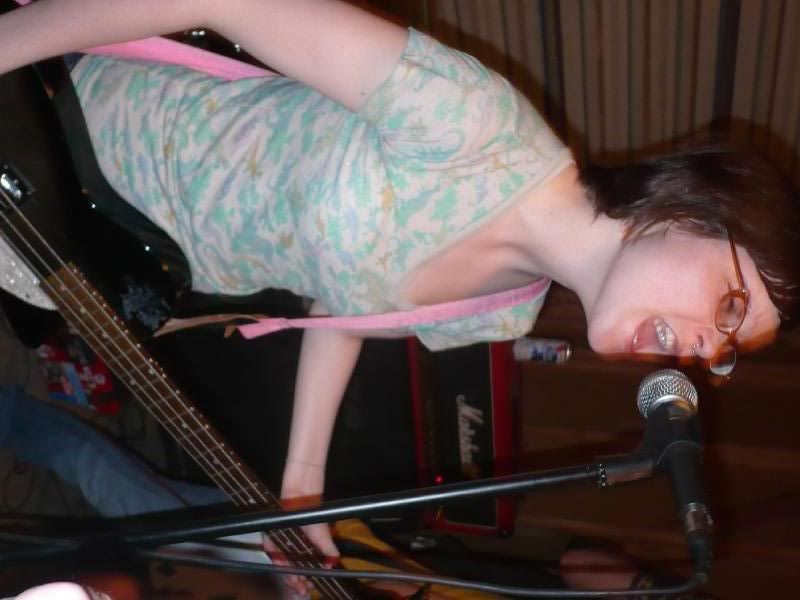
Michelle Shirelle photo by Kelly Lynn Sullivan

Driving 1500 miles in just slightly more than two days to see a band that plays every other week or so in your home town might not seem like the smartest use of one's time or money, let alone scarce and increasingly expensive petroleum reserves, but it turned out to be the best thing in ages for Matt Lame, Kelly Lynn, Carla Monoxide and myself.

True, the Steinways weren't the only attraction that made this whirlwind jaunt seem so attractive; they were playing with several of the best pop punk/punk bands going these days, including the Copyrights, Dear Landlord, Team Stray, the Dopamines and Be My Doppelganger. But it was still the Steinways, who rarely venture much beyond the NYC/NJ axis, constituting the main attraction.

We rolled out of Brooklyn early (well, 9 am - early by SOME standards) Thursday morning, were extremely lucky with traffic, which was almost nonexistent, and after a swift nine hour ride during which I kept expecting our carload of fun-lovers to start waving their arms back and forth and singing the theme to That 70s Show, arrived at the colorfully but entirely inaccurately named Stink House in Columbus, Ohio with hours to spare. The Steinways, who managed to bumble their way onto Staten Island before finally escaping New York City's orbit, turned up as it was getting dark.

My sole knowledge of/experience with Columbus consists of being taught as a young Michigan Wolverines fan to hate everything in it due to its being the home of the loathsome Ohio State Buckeyes, and a smash and grab (well, very little smashing and quite a lot of grabbing) raid on an outlying supermarket conducted by a vanload of starving hippies at the dawn of the 70s. I deny any connection with said vanload, but have it on good authority that seven of them strolled into the market looking as suspicious as you would expect them to after two weeks cooped up in a van and liberally helped themselves to everything they could carry until the authorities arrived, at which point they made a hasty exit that left little or no time for sightseeing elsewhere in Columbus.

We lounged around the porch of the Stink House on one of the first truly warm and beautiful days of spring and watched Toby, the soccer-playing Corgi being put through his paces until it was time to meander over to The Nude Ranch, which despite the somewhat misleading name turned out to be a relatively respectable punk house on the northern fringes of Columbus' rather substantial ghetto and sporting a big blue Obama '08 sign in the front yard.

The show would take place in a smallish garage at the back; in the meantime, someone had started a campfire, the Steinways unloaded copies of their extremely rare and already much prized by collectors Tour LP, a vinyl-only pressing of their upcoming album, and the still mild breezes wafted the smell of somebody's garlic patch over the assembled revelers.

The only disappointment was the absence from the bill of Delay, Columbus' premier trio of punk/hardcore awesomeness, but Austin, one of the Delay twins, is in a new band, Welcome To Concrete, and they opened the show. Austin plays drums, something which he's pretty new at, but the highlight for me was the bossy girl guitarist who constantly was telling the three boys what to do ("You need to tune your bass." "It'll be okay." "No, just do it now."). Let it be noted that for the most part they readily obeyed.

The Steinways weren't at their absolute best that night owing to Grath's microphone being rather ineffective. It's nice to hear the backup vocals loud and clear for a change, but not at the expensive of drowning out the lead singer. Not that it mattered all that much; the Columbus kids, whose reputation for fun and good times has stretched across the nation, danced and went crazy all the same. They seem to have this strange tradition involving two ratty-looking couch pillows, which get bounced overhead much the way beach balls would. People seemed determined not to let them fall, possibly for fear of scabies or other contamination they might contain.

The Copyrights were absolutely stupendous, even when they had to play in pitch black darkness once the overhead light, which had been flickering off and on all night, finally went out altogether, and Dear Landlord were outstanding as well. After lots of standing around and waving goodbye to the Delay twins, who cycled off into the night with their dutifully attached bike lights and (not matching) helmets, we ourselves headed south for the lovely city of Loveland, a Cincinnati suburb that is also the home of Mr. and Mrs. Lame, aka the parents of our intrepid driver, Matt Lame.

Do you know many parents who would not only wait up until 3:30 in the morning to welcome their son and three of his weird punk rock friends, but be completely and overwhelmingly enthusiastic about it? ("You're Carla Monoxide? Oh my God, you're famous!!") No, me neither. We all had our own beds, a repast of several different kinds of breakfast laid out on the kitchen table, learned everything we'd ever needed to know about Matt Lame's career as a young hockey player, and helped celebrate Mr. Lame's birthday by helping him move the new trellis to its permanent home. Frankly, I could have stayed there for the rest of the trip and enjoyed every minute of it, but destiny awaited us, first in The Other Columbus (Indiana, that is) and later that night in Indianapolis.

I probably never would have heard of the tiny town of Columbus IN were it not home to two PPMB stalwarts who, oddly enough, had never met before this day. Well, not IRL, anyway. Rex Postal, who had been the message board's resident Bad Boy for years before several competitors showed up, discovered what he called "the worst band in history" on Myspace, and was amazed to find that they hailed from Columbus as well. This led in turn to said band's lead singer, Warsau Joe (the band is known as the Resistors), also becoming part of our happy crowd, which led finally (yes, there was a point to all this) to Joe joining up with us for our trek to Indy.

But first we had to take a tour of (don't laugh) the architectural marvels of Columbus, Indiana. No, seriously. As I was first informed by Rex, who's just brimming over with civic pride even though he actually lives in a "suburb" called Taylorsville (apparently known locally as Trailersville), Columbus is internationally known as the home of some of the best modern architecture of our time. Those of you familiar with my feelings about most modern architecture may suspect there's an oxymoron alert dead ahead, but actually, some of it was quite interesting and even picturesque (for examples, see Kelly Lynn's photo blog, which also contains numerous pictures of the shows, the traveling, and even a couple of yours truly.

The show in Indianapolis was a hoot, as they must say somewhere or other. It was situated at the Halloween House, which is located, like the Nude Ranch, just to the north side of the city's rather substantial ghetto, and boasts a small, somewhat odoriferous basement that was just about the right size for tonight's crowd, which included not only the fans (us plus Melissa Jerkface) who'd journeyed from New York, but also a passel more who'd followed along from Ohio, and the various members of the six (6!) bands who were playing. I think a few locals might have turned up, too. No, seriously, the crowd was just about the right size to fill the available space, and fill it they did.

It was my first time seeing Team Stray, Be My Doppelganger and the Dopamines, and though the show was stopped midway through the Dopamines by the cops turning up to deal with some doofus who'd parked across the neighbors' driveway, all were worth the trip in themselves. Cops gone, festivities resumed with the Big Three, highlighted (in my opinion) by the Steinways, who while sometimes inconsistent, were right ON IT for this show, and were all smiles - even the legendarily dour Chris Grivet - right along with the audience.

The bro-down contingent took over the dance floor during the Copyrights set, driving many of us out into the back yard, where the summer-like temperatures of the afternon had given way to a cutting wind and a fitful rain, not ideal for the bozos like, um, me, who had decided that morning to break out the shorts and t-shirts for the first time this season. Pete Repellent, down from Portage IN with the lovely Annika Simple, came out to report that it was like "a damn Pennywise show down there," only with better music. Seriously, the bros were all ripping each other's shirts off for some unspecified reason, and eventually the overhead light got broken out and they continued their homoerotic group grope in the dark, which may have been fun for some, but I only note that the backyard contingent grew steadily larger the entire time.

Show over at about 1:30 am or so: the question is, what do we do now? There'd been noises made about our being able to roll out sleeping bags or blankets (assuming we had them) on the Halloween House floor, but it seemed as though by the time everything and everybody had settled down (and assuming a dry and not too filthy sleeping bag spot could be found), it would practically be time to get up and start driving to New York. So, in one of those fits of irrational exuberance that characterize (and are occasionally the downfall of) many great enterprises, we set out for New York City then and there.

By the time we'd got gas and a few snacks (perhaps that should be the other way around) and busted out of the Indianapolis city limits, it was closer to 2:30, and the reality of a 700+ mile trip into the rising sun began to set in. But it was too late to stop now, so Matt and I sat up front, him driving and me blabbing about whatever as we listened to Team Stray and (again and again) the Steinways as we blasted across Indiana and Ohio. The sun did indeed come up as expected, somewhere over the brief stretch of West Virginia that's always the most exotic portion of this particular route, and at that point Kelly Lynn took over front seat blabbing about whatever duties for the long slog across Pennsylvania. By the time we hit New Jersey, all of us were awake again, the day had grown warm and incredibly beautiful (hey, even New Jersey looked fabulous, what can I say?), and we were just about home again from the best road trip ever. A bit of nonsense getting through the Saturday afternoon Canal Street traffic was the only blip on the horizon, but Matt Lame, who'd driven every inch of the way (the man is a GENIUS, with a constitution of iron, no, make that TITANIUM), neatly navigated us through that, and by 2 in the afternoon I was safely back in Brooklyn. The best 53 hours I've spent in, well, just about ever.

13 April 2008

Coast To Coast

Wow, after a very hectic week on America's two most prominent coasts, I'm back mouldering away in Brooklyn amid piles of un-put away laundry, papers, musical instruments and unrealized dreams and ambitions.

For a couple days I was completely Off The Grid, as in utterly devoid and bereft of any internet access, a sobering and slightly frightening predicament to find myself in, though I suppose I should be more frightened by the realization of how utterly dependent I've become on this still relatively recent invention. One of my stock Boring/Grumpy Old Man anecdotes involves the first time I ever heard of "the internet," which would have been sometime around 1985 or 86, when a friend named Tom Jennings told me about something he was working on called FidoNet, which, he promised me, would allow "computers to talk to each other." "But why," I asked him, more seriously than not, "would they want to do that?"

Now I'm more likely to go into a cold sweat worrying about what might happen to civilization if terrorists or space invaders managed to get their hands on an electronic death ray that would wipe out all the information currently stored in cyberspace. Would the result be something akin to what happened to the Native Americans when disease, warfare and starvation eliminated their oral tradition-based culture's equivalent of the Library of Congress, i.e., the generation of elders who knew how most things were done? I suspect it very well might.

Around midweek I did manage to nip out to a cafe that offered wireless service, but such was my schedule that I was barely able to do more than make a quick check of my email to ascertain that nobody was either offering or demanding large sums of money before getting back to the twin purposes of my quick visit to California, which were to help out my mother with a few things and to visit my old dentist for the routine checkup I should have had some months ago but haven't, owing to my seeming inability to find a suitable dentist in New York.

Everything was going along swimmingly on that front until the dentist encountered a suspicious spot on one of my back teeth. It's fairly minor stuff compared with, I imagine, how news of a suspicious spot on, say, the lung, would be greeted, but it was still a bit troubling, in that I was due to return to New York very early the next morning yet was being told that I needed immediate root canal treatment if I wanted to save the tooth in question.

Now I'm one of those people who has never had a root canal, and who wasn't even too clear what it is, but that is no longer the case. By 4 o'clock that afternoon I was sitting in the very expensively furnished (and when I saw the bill I could see how and why) offices of an endodontist, who proceeded to prop open my jaw with a large chunk of rubber and drill and poke away in there for the worse part of an hour and a half. Not painful, really, apart from the aforementioned bill and the difficulty of restoring my jaw to normal functioning once the rubber block had finally been removed, but not the way I would have preferred to spend my last day in California, either.

Other California adventures: I went to Oakland, something I generally avoid doing unless absolutely necessary. And not just to the Berkeley-lite precincts of North Oakland's punk ghetto, but to the very heart of the beast in sad, disused downtown. My actual destination was the County Building, where I was going to try to persuade them that I didn't actually owe them thousands of dollars in 2001-2005 taxes for a company that I haven't owned since 1997.

It took me three tries to get through the metal detector at the building entrance (I usually have a much easier time of it at airports), which didn't fill me with confidence about the level of service I was likely to receive once inside: if they were that worried about being stabbed or shot by irate citizens, I reasoned, there must be a pretty high level of customer dissatisfaction.

But as it turned out, there were no long lines, no surly clerks, and the lady who waited on me didn't even seem to be especially incompetent. She simply told me there was "no record" of either me or the company that was being dunned for back taxes. Then why is it on my credit report, I asked, to be met with a shrug that was as eloquent as it was inarticulate.

My business done, I was free to wander around downtown for a couple hours, something I wouldn't recommend doing after dark, but which seemed perfectly - well, maybe not perfectly, but almost - safe at 11 in the morning when, one presumes, most villains hadn't yet roused themselves from crackhead slumber.

I had fond memories of the Oakland Museum, so I decided to revisit it for the first time in some 30 years, but just before I handed over my money, I fortunately caught sight of a sign informing potential patrons that the art and history wings would be closed for renovation until 2009. Since I don't remember ever seeing anything of interest in the Oakland Museum that didn't involve art or history, I decided the "special reduced" price of $6 would still be no bargain, and headed off to explore some of the mostly deserted back streets.

Bear in mind that this is a Wednesday morning, not a public holiday, and a beautiful, sunny day, yet very little is going on in the way of business, shopping, or anything else in the downtown of the Bay Area's third largest city. Even Berkeley's bedraggled downtown (its last "department store," Ross Dress For Less, is now a empty shell) was a hotbed of activity by comparison.

Sad? Very. Downtown Oakland is full of nice or at least decent looking apartments, both old and new, the weather is about as good as you get in this part of the Bay Area, there's a large junior college within walking distance, and tons of empty office and retail space, yet the place is languishing like some shabby urban district on the fringe of the third world. In fact it reminded me of films and photos I've seen of some South African cities, where rampant crime has turned once-thriving commercial districts into no-go areas for most legitimate activity.

To compare Oakland to South Africa would on most levels be gross hyperbole, but to the extent that citizens feel almost completely unprotected by the local police (during my three hours downtown I never saw a single cop), it is not. And the fact that despite hundreds of millions of dollars in investment and new construction, downtown Oakland still is an unhealthy shadow of the city it was 40 or 50 years ago speaks all the volumes you might want to read. Sad, really sad.

Meanwhile, back in the suburbs to the north, my old friends Pat and Erika ever so kindly donated a computer of theirs to my mother, which restored both her and myself to the wonderful world of dialup internet access. To my mother, who's never known anything else, this was great news indeed, but as someone who's been accustomed to broadband for quite a few years now, I must confess to being slightly agog at the amount of time it takes to send a simple email or even just get online at all. People live like this on a regular basis, I kept marveling?

Actually, it wasn't that big of a deal at all, really; I suspect I'm telling the story mainly as an extended way of excusing myself for no blog posts all week. What else happened in California? I was SO cold. The first two nights I woke up in the middle of the night dreaming of blizzards and icicles, and even after adding an additional two blankets, I still risked frostbite to any part of me that drifted out from under them.

Then on the morning I was due to come home, the winds died down, the sun rose in a clear blue sky, and a warmth and easy tranquility settled over the land. Even as I walked to the BART station at 5:45 am I could tell it was going to be a spectacular day, and as my plane took off a sight of San Francisco's alabaster spires gleaming and basking in the morning sun confirmed this.

I landed in a foggy, drizzly New York that seemed far closer to full-on spring than when I left it four days earlier, and went almost straight to the Weakerthans show in Williamsburg. As much as I was looking forward to seeing the Weakerthans (and Christine Fellows and A.A. Bondy) again, my principal mission, one I've been pursuing for some years now, was to bring together two of my favorite writers and musicians, John K. Samson and Aaron Cometbus. And this time it finally worked.

Not without some hitches, it's true; Aaron overslept and didn't show up at the club until after 11, and there was some funny business at the door when the bouncer demanded ID before letting him in, to which Aaron responded that he not only didn't have any, but also didn't need any. I can't imagine that line working on too many bouncers in this town, but as delivered by Aaron it worked as effectively as any Jedi mind trick. The bouncer's eyes just sort of glazed over and he was reduced to mumbling, "Well, you better bring it next time" as Aaron casually strolled past him.

And just as I'd always anticipated, John and Aaron hit it off wonderfully, to the point where I almost felt like a third wheel, though I did get included in a some of the photos. At one point Christine Fellows jumped up and started whirling Aaron around in some sort of exuberant Winnipeg-goes-to-Brooklyn dance, and then it was time to pack up the show, wave goodbye to the Weakerthans, and make our way back through the spectacular thunderstorm streets of Brooklyn.

I was completely soaked by the time I got home (Cometbus and his umbrella having departed at the subway stop some blocks away), but outside it was a warm spring night and inside I curled up next to the radiator. By morning the sun had come out again and the the early spring of morning had turned into almost summer by the time night rolled around. I was out all day, from South Brooklyn to Midtown to the East Village, and so, it seemed, was just about everyone else in New York City. You spend all winter dreaming about what it will be like when the warm weather finally comes back, and when it does, it's almost as though you don't know what to do except walk around marveling at it. Today the cold and clouds blew back in and it feels more like March again, but there's no longer any doubt in anyone's mind: winter is well and truly dead, and summer is slowly but surely steaming into sight.

06 April 2008

April Is The Coolest Month

Well, no, not really; in fact the first time I encountered the opening lines of T.S. Eliot's The Wasteland (some industrious vandal had carved the entire first stanza into the wet cement of a new sidewalk in Berkeley), I was pretty sure I knew exactly why the poet had called April the cruelest month.

There was the way an April day could turn on a dime from bright promise to abject misery, how the spectacular sunshine seen when looking out your window could mask a fierce and vicious north wind, or how yesterday's summerlike temperatures could dissolve overnight into a late season blizzard.

The opposite also happens, of course: yesterday and today were predicted to be cold and filled with nonstop rain; instead, the clouds started drifting away after a few sprinkles to be replaced by gorgeous sunshine and the first real day of spring. McCarren Park roared into life, with more joggers, ball players, promenaders and loungers per square foot than you'd think could be accommodated in Times Square and Grand Central Station, and all up and down the winter-worn back streets of Brooklyn people came spilling out onto the sidewalks. The more industrious ones waxed their cars or picked away at the debris that had accumulated in their postage-stamp-sized gardens; others were content to turn their stereos up loud and shout back and forth across the street at friends and neighbors who'd been missing in action these past few months.

A few more days of this and all the trees will be in bloom, with new leaves not far behind; naturally they're predicting that tomorrow will mark a return to rain and cold, but that doesn't come close to representing April's cruelest joke, which the poet comes closest to capturing when he refers to, "breeding lilacs out of the dead land, mixing memory and desire, stirring dull roots with spring rain."

"Winter kept us warm, covering Earth in forgetful snow," he continues, and therein lies the rub: huddled indoors, concerned mainly with staying warm and keeping the elements at bay, it's easier not to think about the problematic aspects of our lives. But stripped of our layers of excess clothing and thrown into the giddy streets with thousands of our rapturously expectant fellows and our memories don't just mix with desire, they become it.

Everything we didn't do, everything that failed to come true last spring and summer or in the succession of springs and summers previous, lies before us once more, only this time it's going to be different, this time we're going to grab life by the scruff and bend it to our needs and wills. And even if we've lived long enough to have learned repeatedly that while some things change for the better - dramatically so, in some cases - the mistakes and shortcomings and disappointments of our past have a resilience all their own.

It's been observed by historians that revolutions most often occur not when conditions are at their worst, but when they have started to improve. People don't behead tyrants when they are starving in their hovels, but rather when they have just enough food in their bellies to stir up hopes of better days and belief in not only their ability, but their duty to bring them about.

So too does the lonely soul, the spurned lover, the artist or poet who has wintered in quiet desperation greet the spring with the determination that this year everything is going to be different. By the time June or July comes around, they swear, that new manuscript will be written, those excess pounds will have fallen away, strolls in the park will be hand-in-hand with the long-awaited new and perfect partner. Why, just look around, the reasoning goes: the streets are practically brimming over with happiness, some of it is bound to splash my way even if only by accident.

And it will, for some but not all. And while the blessed ones revel in the lazy richness of high summer, those who feel left behind grow bitter and begin to long for the early death of autumn and the oblivion of another winter. But that's a rather gloomy way of looking at it, wouldn't you say? Especially after a beautiful day like today, so I take back anything unkind I ever said about the month of April, and if I had a way of getting hold of T.S. Eliot, I'd make him do the same. This year April is going to be cool for all of us. Deal?

01 April 2008

Doomsday

Perhaps inspired by a newfound awareness of how much it annoys people when I express enjoyment of trashy, lowbrow movies, I went to see another one yesterday. This one was called Doomsday, and while I couldn't in good conscience recommend it for anyone over the age of 14 or so, it was a decent bit of escapism, with a fair few explosions, completely preposterous plotlines, and... well, that's about it.

Somehow I had gotten the impression that this updated bit of Mad Max-style tomfoolery was set in New York City, which would have heightened the enjoyment for me, but in fact it took place in London and (mostly) Glasgow, and all the serious damage unfolded in Glasgow. There seems to be some perverse element of human nature that revels in seeing one's home town or former home town demolished in the movies, but although I've visited there once, I frankly can't be bothered about what happens to Glasgow. Anyway, apart from the street signs, it looked more like Edinburgh, which I also can't be much bothered about.

The premise, as if one were needed, was lifted straight from 28 Days Later: a killer virus has ravaged the UK, well, actually only Scotland, and the government has responded by doing what many an Englishman has no doubt fantasized about doing, building a 30 foot high wall along the English-Scottish border and leaving the Scots to bloodily expire. 30 years later, one of the few escapees from the Scottish holocaust is a crack SAS trooper or somesuch and stationed in a rather dark and down-at-the-heels London (one suspects that a Scot had something to with the making of this film, based on its assumption that the English economy and body politic would be all but ruined should the Scottish albatross be lifted from its neck).

The virus has just been discovered in London, and people's heads are beginning to explode on a routine basis; simultaneously it's revealed that there are survivors in Scotland, so an expedition is organized to travel into the Dead Zone, capture one of them, and use his or her blood to make a vaccine and save England. Well, you can probably see where this is going from here, although the crack SAS trooper also happens to be a beautiful female martial arts expert and cold-blooded killer, the English government officials are craven and corrupt (further buttressing my assumption that a Scot was involved with this), all except for good old Bob Hoskins, who spends most of his onscreen time lighting cigarettes and looking utterly bewildered as to what he's doing in this B-grade piece of crap.

Once north of the border, the commandos come tooling into a darkened, ruined Glasgow (apart from the vines growing on the buildings, it looked rather like a normal night) which appears to be completely empty until suddenly out of nowhere come thousands of 1984-style chaos and crusty punks (the mind boggles at how many unemployable tattooed-face 1980s burnouts must have supplemented their giros by working as extras) who have of course reverted to savagery, not that they had far to revert in the first place, and are bent on cannibalizing our intrepid English adventurers.

You'll remember that the entire country was blacked out and had been for 30 years, but suddenly, as though by magic, the crusties have sufficient electricity and microphones to have an impromptu punk/metal show complete with torture, incineration and cannibalism that looked as though it could have been filmed at the old Bondage-a-Go-Go club nights at San Francisco's Trocadero. Our heroes manage to escape - well, the ones who aren't eaten, that is - and in an even more amazingly magical turn of events, find a train sitting in Glasgow Central that still operates (and what do you know, despite 30 years of chaos and destruction, the railroad tracks are in perfect working order as well, without a single obstruction for the hundred miles or so that it takes them to journey out to the highlands where another bunch of survivors has taken refuge in an ancient castle and reverted to medievalism.

Much jousting, sword fighting, knights in armor, etc. ensues, and ultimately the couple of soldiers who have survived managed to deliver their prize, a living immune girl, back to the English authorities, who turn out to be not just craven and corrupt, but completely and utterly bereft of all human decency, and who are planning to let most of London die first in the belief it will convey some sort of political advantage (so sure was I that a Scotsman had to have made this that I just googled the writer-director, only to find out he's actually a Geordie - well, close enough).

Everything is more or less settled then, when the heroine comes up with some tape disc that exposes the English Prime Minister for the lying sod that he is (and England collectively shrugs its shoulders, one would imagine) before going back to kill the leader of the crusty cannibals and become their new leader. As you do.

Well, there you go; no need to see this movie now, I suppose, unless of course you're in the aforementioned under-14 demographic, in which case you'll have to sneak in, as this lovely little gorefest is rated R-17 for some reason. If you go, take lots of popcorn.

30 March 2008

"Film" And The Overly Earnest 20-Something

As a general rule I think it's advisable to avoid criticizing, let alone getting into arguments about movies I haven't seen.

However, there are cases when I'm willing to make exceptions, and this argument qualifies as one of them. My prejudice against No Country For Old Men didn't emerge full-blown out of thin air; in fact, when I first heard about the movie, a month or two before it came out, it sounded like something I'd probably be inclined to see.

I'd never read the book, nor did I know much about the subject matter, but people seemed to be making a big deal of it, and the Coen Brothers not only have a decent reputation, but also have made some other movies I've enjoyed. But within a week or two of its opening, friends who'd seen it started reporting back to me that it was simply awful, the worst sort of pseudo-intellectual, quasi-artistic dreck.

Well, that's not exactly how most of them put it. To be precise, the critiques generally revolved around two points: "Makes no sense" and "Long, convoluted and boring." But when a few of my young friends, largely those of the painfully earnest ilk, the sort who speak of "film" in hushed, reverential tones and collect DVDs so they can make repeated studies comparing and contrasting the director's cut with the commercial cinema cut and the alternative ending cut released only in Bulgaria and the eastern half of the Ukraine, began raving that No Country For Old Men was a "stunning masterpiece," "hauntingly evocative," and all the rest of that cine-crit blah-blah, I felt confident that my initial instincts had been correct.

I mean most of us do this, right? We have two sets of critics who help us decide which movies, records, books, etc. we are going to take a flyer on and which we are going to give a miss. Doesn't matter whether they are professionals, amateurs, or just our friends and acquaintances; it's just that we've got enough of an idea about what they like and don't like that we can draw reasonable inferences about whether we ourselves would like the product in question.

One set, of course, consists of those people who tend to view life, love and art in much the same way we do; the other is what I would informally call the null set, i.e., you know that pretty much anything they like is going to suck on a stupendous scale.

Before too much umbrage is taken, snits gone into, and goats gotten, let me hasten to add that there is nothing remotely objective or scientific about this method; it's purely a matter of personal taste (or lack thereof). However, I've come to notice that one of the surest predictors of records I don't want to listen to, movies I don't want to see, etc., is its popularity with the beard and/or chin-stroking 20-something "artistic" crowd. You know the type, no doubt: the ones who shortly after leaving their teens begin denouncing the catchy, fun pop-punk music they used to love as "puerile" and "simplistic," replacing it with "more complex" varieties, the more obscure, atonal and unlikely to become popular, the better.

And heaven knows we can all be guilty of patronizing and condescending attitudes from time to time, but you haven't truly been patronized or condescended to until a mid to late-20s art school dropout has casually sneered something to the effect of, "Oh, I suppose that (your favorite band, movie, artist, etc.) sort of thing is all right if you're into mainstream pop culture."

If you read far enough along in the thread I linked to, you'll see that one such commentator dismisses my views out of hand because, "You have zero interest in film, you just watch movies because you're bored." However, I think he's got things backward; the only time boredom and movies (note, by the way, how I have zero interest in "film" and only watch "movies") intersect for me is when I see turgid, overblown melodramas like There Will Be Blood and, I'm guessing, No County For Old Men.

I once made a practice of seeing movies, especially those with subtitles because I thought I "should" or because they were "important," but as the Dylan song goes, I was so much older then. My critic also suggests that I go to movies to "kill time," but it's been many years since I've had too much time on my hands; time is one commodity that is perennially in short supply with me.

So when I choose a movie, I have only one criterion: will it entertain me? I don't care if its lowbrow, highbrow, or nobrow, whether it's a crassly commercial enterprise or ars gratia artis, if I'm laying out 10 bucks and a couple of hours of my time, I want to be pretty damn sure I'll have something to laugh and/or cry about, not something that forces me to ponder, "What the hell was that supposed to be and why did it have to take two and a half hours out of my life?"

That being said, I saw an excellent movie today called The Bank Job. Nonstop action, clever plot (and based on a true story, they claim; I certainly remember the phony-baloney black activist Michael X who features in it). Story aside, it always delivers a mostly realistic trip back into the gritty and gray London of the early 70s; I say "mostly" only because I caught one anachronism: one scene in the Baker Street Underground station includes the correct 1970s-style trains, but shows a wall sign reading "Hammersmith and City Line," a line which of course didn't come into being until 1988 (I'm not really that much of a trainspotter, honest; it's just that I lived on the H&C and it's predecessor, the Metropolitan, for a number of years).

Anyway, The Bank Job is my idea of a movie that does exactly what movies are supposed to do, informs, entertains and inspires (or at least one or two of the aforementioned). All you lovers of "film," feel free to have at me for my philistinism (yes, that was another charge leveled at me during the discussion, by an actual art student, as it happens). I'll only add that ever since I started picking movies on their entertainment value rather than their cultural significance, the quality of my leisure time has noticeably improved. Not to mention the added enjoyment derived from ruffling the carefully preened feathers of the art school booboisie.

28 March 2008

Five Miles Of Sheer Terror

I spent most of the afternoon and evening in Ann Arbor chatting with an old friend, one of the few remaining people I know in this town, and who has the added distinction of having grown up in the same Downriver neighborhood that I did and attending the same high school I did, albeit a couple decades later than me.

But we have quite a few people, places and things in common, definitely enough to keep us blabbing away without much regard for the passage of time or the deteriorating state of the weather. We started out in a joint called El Sabor Latino on N. Main Street, quite near the police station and jail that played a featured role in many of the escapades of my youth. The waitress was a black lady about my age, who, this being the Sabor "Latino," I reckoned to be Cuban or Puerto Rican. Until she opened her mouth, that is, at which point I said, "Jaime, that lady has an Ann Arbor accent."

And by "Ann Arbor accent" I was referring not to a sense of place but rather of time: she spoke the way a certain segment of the population did in the Ann Arbor of the early 70s, that certain segment being many if not most of the people I hung around and, in between multiple tokes from multiple joints, plotted political, cultural and social revolutions. It's a distinct manner of speaking, the likes of which I've never really heard elsewhere, that combines a flat Midwestern matter-of-factness with an edgy whine accentuated by a slightly confrontational flaring of the nostrils.

It's not entirely unpleasant if you're familiar with it, but I imagine it can be off-putting to outsiders, and I've been gone long enough that my first reaction was to wonder if she was going to start turning over the tables and demanding that we choose whether we were going to be part of the problem or part of the solution, but in fact all she wanted to know was whether we'd be having flour or corn tortillas.

By the time we'd finished, the persistent rain was in the process of changing to persistent snow, but it being too warm for it to stick to the pavement, we moseyed on down to State Street and the Espresso Royale Cafe, a topnotch place for lounging about for hours on end, which we and numerous other people of leisure proceeded to do. I couldn't get over how huge the place was (it's two large storefronts knocked into one) compared with cafes in New York or London, where finding a table and chair is often a major accomplishment, let alone being able to slide a couple tables together for just the two of you and still have acres of space and empty tables around you. This seemed like the ideal place to gossip, and so we did, ultimately finishing up on the Dee Dee Ramone story, of which a couple of the last sad chapters were played out here in Ann Arbor at the nearby home of a mutual friend of ours.

About this time we were ready to head over to Downriver, to Southgate specifically, to see my friends The Challenged, on tour from back home in Brooklyn. But much to our chagrin (well, mine in particular, as I was the one who would have to drive in it), the snow had begun piling up on the streets an hour or two earlier, and had turned them into quite a mess. We drove as far as Jaime's house, about a mile away, before realizing that a trip most of the way to Detroit would be difficult and unpleasant, and, if the snow kept up, downright dangerous by the time we drove back.

So I called Colin from the Challenged and explained the situation; he agreed that it sucked and that they were going to try and get out of there right after they played and head south toward their next gig in Columbus, Ohio on the theory that, well, it was south of here, so maybe it wouldn't be snowing as much (much later tonight I heard back from him on I-75, where the theory hadn't quite panned out, as visibility was so bad they were having trouble finding an exit. Any exit, that is.

So Jaime stayed in and continued talking till about midnight, at which point I went outside to discover that the snow had kept up and it was downright dangerous, even for the 5 miles (by surface streets) or 6.6 miles (partly via freeway) back to my motel. I haven't driven on snow for a long time, and if it were up to me, it would have been a lot longer, but I didn't have much choice, and so I set off at an average speed of 5-7 miles per hour, gradually upping it, when conditions seemed to allow, to a daring 10 mph.

You can imagine how the other drivers, most of them obviously born and bred driving in this crap, felt about that, and they tried to get around me any way they could. I would have been happy to pull over and let them pass, but I couldn't even tap lightly on the brakes without starting to go into a skid. When I got to the hilly north side of town, it got much worse, because I not only had to worry about sliding rather than rolling down the hill, I often had no idea how or if I'd be able to stop when I got to the bottom. And the entire way there was not a snowplow or salt truck in sight, nor any evidence that one had passed through the area in at least the past week or so.

I wondered if it had anything to do with the state of Michigan being so broke it couldn't afford such luxuries as snow removal, or if it had more to do with superciliously disengaged Ann Arborites not wanting to be seen making a big deal out of some silly snowstorm, preferring to let nature take its course and haul away the wreckage and the bodies in the morning when the weather had improved.

Long story short - wait, I think it's already long, sorry - I did make it back to the motel, where I'm now safely ensconced and hoping that the storm will have let up by morning when I have to head back to the airport and civilization. or at least to a place where it rarely snows and where you'll seldom if ever catch me attempting to drive a car. Or as B. Dylan memorably opined, "I'm going back to New York City, I do believe I've had enough."

27 March 2008

Michigan Seems Like A Dream To Me Now

I swear I've used that title before, but what the heck, all the leaves are brown and the sky is gray, and my mother woke me up just past noon calling from California, which is just as well, as in my dream I was having a unending argument with this very exasperating person on the beach.

How's that for a scattershot opening? No? It'll have to do, because while I've been carrying around an outstanding first sentence ever since last night, it seems to have flown away on the wings of sleep and though I still have a number of things to tell you, I can't for the life of me remember how I meant to begin telling you about them.

Never mind, then; I'm holed up in a chilly but otherwise cozy little motel room outside of my ancestral hippie home of Ann Arbor, where I came last night to see my old friends, the Weakerthans, who in addition to the usual gifts of fellowship and great music, presented me with this outstanding t-shirt seen on the right. The show was at the Blind Pig, which I remember complaining about when it opened because it was "commercializing" our hippie culture. This was in 1972, apparently, but by 1973 I was visiting it regularly because it was one of the only places in town where you could get the cappuccino I had grown used to out in California.

Anyway, I'm apparently over any issues I might have had with the Blind Pig, fortunately, and I thoroughly enjoyed the show except for the fact that, as I discovered to my chagrin, Michigan is one of the only places left in the (allegedly) civilized word that STILL allows people to smoke indoors in public places. I mean, come on, people, what century is this already? Also very much enjoyed the opening acts, Christine Fellows (who's also joining in as the fifth Weakerthan on this tour, and one A.A. Bondy, who in the past several decades is the first and only Dylanesque singer-songwriter (well, unless you count J. K. Samson in his solo persona) that I have ever been fully impressed by. I was also excited by the opportunity to introduce him to all of you, on the premise that if I had never heard of him before, nobody else had either, but I see he's playing on Conan O'Brien April 11, the same day he'll be appearing with the Weakerthans back home in Williamsburg. Back home for me, that is, not him.

So, flying to Detroit was a bit depressing. For some reason, tucked in among my keepsakes and memorabilia I used to have a flight schedule from 1966 detailing the flights between Detroit and LaGuardia (including the fare: $16). Back then, when I made my first visits to New York, there were flights pretty much on the hour, and they were in full-sized airplanes packed full of people doing (presumably) important things in both places. Now there's only a handful of flights per day, they're in those little toy airplanes where they don't even have room for overhead baggage, and even then the plane was only half full.

And landing at Detroit Metropolitan (do they still even call it that?) was like time traveling back to the 50s or 60s; at least the terminal they dumped us off at (outside of, that is; we had to walk across the tarmac just like in those old time movies) had scarcely changed at all since the first time I came through there in 1964 or so. The rent-a-car guy told me he was upgrading my compact car to a luxury convertible at no charge, which I didn't see any advantage to, since it's about 40 degrees and fitfully raining and snowing outside, but unless convertibles now have metal tops that don't open, I think he was confused. Pulling out of the airport, I impulsively turned right instead of left and headed toward my old Downriver stomping grounds, where I was strangely appalled at how small and desperate all the houses looked.

Odd, that, since I've been back many - well, at least 10 - times over the years, and I'd never particularly noticed that aspect. Well, the small part, maybe, but desperate? Maybe it was just the last-days-of-winter malaise that I remember settling over the place every year as a boy just before spring burst into sight. Drove past my childhood home and didn't approve of what the new owners had done, like cutting down all but one of the trees and shrubs, went past the school where I got drunk for the first time (and also, a couple years later, got arrested for the first time), past the spot down by the creek where in April 1961 I met up with my first gang, past the other school where we hung out through the summers of 61 and 62, and the drug store across the street, where they'd finally wised up and removed the bench that we always used to lounge around on.

Then, still not having had enough nostalgia, I headed into Detroit proper, or what's left of it, and strangely enough (maybe because the sun had come out by now), it didn't look nearly as bad as it has the last few times I've been there. Oh, also past the park where I first saw the MC5 play on a tennis court in 1965 or 66, and then out Clark Street and onto Michigan Avenue, where things did start looking a bit more like the ruined, post-apocalyptic Detroit that I've come to know over the past couple decades. But even there I saw signs of life, especially in the form of many new immigrants who were blithely strolling past the wreckage as if it never occurred to them to ask, "I left Chiapas/Baghdad/Sierra Leone for this?"

It was almost dark by the time I got to Ann Arbor, but there was still time to look around at what still strikes me, despite its many changes in recent years, as a beautiful and excellent town. Parts of it look like a living museum to small town America of a century ago, and I stopped in one shop to look at some photo books that showed me that indeed, many parts of town had changed very little in the interim. Also found a photo book full of shots of Detroit when I was a kid, when downtown was a place of wonder, a bustling, vibrant city that resembled Manhattan or Chicago rather than the squalid wasteland it's now become.

The reason I went into the bookshop was an odd one: for some reason, while strolling past, I had a sudden inexplicable impulse to buy a copy of Maximum Rocknroll, a magazine I've only seen once in the last five years, and haven't bought in longer than that. It's not so much that I've been boycotting them, it's more that at some point they made one of those ideologically motivated punker-than-thou decisions to the effect that their distributor was getting too successful, so they started doing their own distribution and subsequently disappeared from the great majority of stores that used to carry it.

But for some reason, I knew this particular Borders (did you know Ann Arbor was the home of the original Borders, and that it was once a tiny cornershop itself? Domino's Pizza had its start here as well) would be carrying MRR, and sure enough it was. Having picked up my copy, I was shocked - and, I'll admit, a little pleased - to discover that they were still talking about me. Well, one columnist, anyway, but last time I perused a copy, about two years ago, I was mentioned in two columns, which led me to wonder in a vainglorious way if this was a bit of odd serendipity or if I was a regular subject in a magazine I hadn't been a part of since 1994.

Apart from that, however, it was interesting to see how the magazine has carried on in the absence of Tim Yohannan, different in some aspects, but fundamentally the same, much as Gilman Street did after Tim moved on. Even if it's no longer a magazine I'd regularly pick up and read, it's sort of reassuring to know that it's still there and still carrying on the struggle for... well, for exactly what, I'm not quite sure, but they're struggling nonetheless. Actually, I'm kind of glad to know they're there in a world where so much of what used to be isn't.

26 March 2008

First Flowers

Back in New York, and while there's still a distinct chill in the air, today was full of the sort of dazzling sunshine that was conspicuous by its complete absence in Miami. Had to go into the city today, and while cutting through the apartments (projects? I don't know which they are) on E. 5th between 1st and Avenue A, I spied a hedgerow of forsythia in the process of bursting into full bloom.

Since it's usually one of the first spring flowers you see, unless you're in the habit of walking around with downcast eyes, in which case you might spot some crocuses, which I also saw today. It was kind of hard to believe; only a week ago, there was scarcely a sign of life except for some buds beginning to swell on the trees, and the city still looked as cold and barren and windswept as it did at midwinter; now out seemingly nowhere, flowers are emerging everywhere. I'm supposed to be out of town for a couple more days this week, and I really am reluctant to go for fear I'll miss the next exciting development.

Although yellow's not my favorite color, I'm willing to make an exception for the forsythia; I remember as a child seeing how excited and pleased my mother would get when the two big bushes flanking the side door would burst into bloom around the beginning of April and the promise of summer that they seemed to carry with them. My mother's other favorite flower was the tulip, and she had planted them all around the back yard. I loved them too, and the year I was four or five, I grew impatient waiting for the buds to open, so I went around one frosty April morning and opened them myself. Not only was I deeply chagrined to find no beautiful flowers inside, but the following night's frost turned them all to blackened stubs and turned that year into the Spring With No Tulips. I didn't even get lectured or spanked for that one; my mother in her wisdom let the unhappy results of what I had done serve as the best possible punishment.

In other news, I stopped by the library today and picked up a copy of Moby Dick. This is a book I've tried to read several times, has been recommended highly by innumerable friends, and of course is regarded as one of the great classics of American literature. I even bought a copy of it once, but never got past the first chapter or two; I found it, or so I remember saying at the time, verbose, tendentious, and tedious. But today, I took another look at that same first paragraph that had previously only annoyed or discouraged me, and I was hooked. This is absolutely brilliant, I kept remarking to myself, and have been plowing right through the first several chapters on the subway and at dinner tonight. Apparently it was just a matter of time before I was ready or able to appreciate it. Curious, that, considering that some of the book's biggest fans I've known read it in their 20s or even in their teens, which I most definitely couldn't or wouldn't have done. Ah well, all in good time, and let's just hope I don't wind up talking like a sailor before I'm finished with it.

24 March 2008

False Advertising And My Journey To South Beach

As long as I can remember, Florida license plates have borne the slogan "Sunshine State." Interestingly (well, I thought so, anyway), so do those of the Australian state Queensland, which for a while also had a design and color scheme similar to old school Florida plates.

The difference is that in Queensland there actually is a lot of sunshine. In the outback sections, there's so much of it that the earth is parched and cracked and almost nothing grows there, but when you get up to the northeastern corner, you find tropical rain forests, which would imply that, yes, quite a bit of rain falls there, although it's mostly limited to the rainy season. Okay, the rainy season takes up nearly half the year, but even during that time, you still get bursts of sunshine poking through the clouds periodically. And, of course, you get incredibly lush and exotic vegetation and all sorts of strange, creepy crawly creatures.

Meanwhile, back in Florida, I see plenty of palm trees, and they're splendid as palm trees go (though I discovered today that many of them are coconut-bearing palm trees, which had me nervously looking upward during much of my walk down to the other end of town today), but lush, verdant, exotic vegetation? Not a lot of it, frankly. No rain forests in sight. But plenty, oh yes, plenty of rain. The kind of cascading, torrential rain that you see in Midwestern thunderstorms or, possibly, hurricanes.

And here's the kicker: Florida has a rainy season, too. But it starts in May, not March. We are in the dry season, allegedly. But somehow that didn't stop yesterday from being a complete washout and today was pretty much the same story.

True, the morning dawned semi-bright and semi-sunny after a night of pretty much constant rain (following a day of pretty much constant rain), but by the time I was able to get started on my long-planned hiking trip down to South Beach (approximately 5.8 miles), the clouds were back. The drizzle started almost as soon as I was out of sight of the hotel, and at the one-mile mark I had to take refuge, first under a palm tree and then under a bus shelter for about 45 minutes before little patches of blue sky re-emerged, along with 3.5 minutes (I timed it) of actual sunshine.

The next part of my walk was the best. Although the sun remained mostly out of sight, it wasn't lurking so far behind the clouds that there wasn't considerable brightness and warmth in the air, and the couple million gallons of water that had just been precipitously dropped on the city made everything look and smell particularly charming. Incidentally, as I was watching a substantial portion of those gallons swirl down a storm drain, I wondered what provision local authorities had made for capturing the abundant rainwater and using it to supplement the city's supply instead of drawing down the Biscayne Aquifer.

Answer: none, apparently; instead, they're relying on benzene-poisoned well water because, oh, I don't know, I guess it would be too much trouble to build cisterns and reservoirs to capture all that free water from the sky. Simpler to let it all run off into the ocean and then, when Florida inevitably runs out of fresh water, spend zillions of dollars building plants to desalinate it again.

It doesn't even all run off; there were many flooded streets, today. Luckily I was wearing my brand new pair of waterproof internet shoes and I came through high and dry. Finally got to Lincoln Road, which is kind of like a shopping mall disguised as a city street, and about which my friends were raving the other night ("It's so cosmopolitan, so international!" And these people are from New York.)

Well, there were a lot of people speaking Spanish and quite a few speaking Portuguese, but apart from one Russian man, that was about it for the international factor. Perhaps I would have seen more except that this was when the heavens opened up again and I spent the next hour and a half huddled under an awning and another half hour after that in an exotic and cosmopolitan Subway sandwich shop where indeed all of the staff spoke Spanish. Gee, I've never been anywhere like that in New York.

But Miami is a different order of Spanish, in that while you hear and see Spanish everywhere in New York, there's never any doubt that it's ultimately an English-speaking city. That's not the case in Miami, and the only reason I would stop short of calling it the first fully bilingual city on the American mainland is that the balance may have already been tipped in favor of it being the first predominantly Spanish-speaking city on the American mainland. There are cities in the Southwest where Spanish is nearly as ubiquitous, but there it tends to be the language of the immigrant working classes; in Miami it permeates all socio-economic levels, and one gets the impression that it would be easy to live a very full life indeed here without ever bothering to learn English. And when a city has reached that point, well, guess what: quite a few people are not going to bother to learn English. Not a complaint, just an observation.

When the thunder stopped crashing and the rain stopped flashing, I was all but ready to give up on my expedition and head back for the hotel, but the sky had brightened up enough to make it look worthwhile chancing a bit more of a walk. So I made it down to the heart of South Beach after all, to all the pretty pastel pink and yellow and blue buildings on the quiet back streets, the stretch of Washington Avenue with its large selection of very artsy and eccentric beggars and tramps (and some extremely pitiable ones as well), and finally the stretch of Ocean Drive where the South American equivalent of Eurotrash bumps up against Spring Break and the A-gay party circuit.

And that was impressive, something I'll admit I've never seen topped by Sydney or, for that matter, anywhere else in the New World; granted, I haven't been to Rio or Buenos Aires, so I'll reserve judgment. I could almost see why my friends are talking about moving there, though I could imagine it getting old, in the sense that while the neighborhood is exciting and vibrant, it's still just one exciting, vibrant neighborhood set down in the midst of ten miles of fairly bland (if nicely colored) apartment buildings. At one point I walked four full miles past NOTHING but apartment buildings, and I mean nothing, and this is on the main drag. No stores, no restaurants, no gas stations, nothing but driveways and a bit of landscaping to break the monotony, not to mention the tedium of having to drive several miles to buy a loaf of bread.

Jane Jacobs would be turning over in her grave; she's the one, you'll remember, who insisted that the secret to a dynamic urban setting was to have people living, working and playing all in the same immediate vicinity, as, for example in her beloved New York. One might say Miami Beach has taken a rather different tack, one which would be hard, though not impossible to remedy. Although the apartment buildings tend to be massive, there's still enough open space to think about slipping in some commercial premises that people could walk to. No doubt it would go completely against current zoning regulations, but once gas hits $10 a gallon or so, people might start changing their tune.

Then the rain started up again and I gave up on walking back to the hotel and hopped the bus instead, where I seemed to be the only English speaker, the driver included. Ended up riding past the hotel (deliberately) to a North Beach (NoBe, some of them call it) shopping area where I had a late night decaf cappuccino at a raucous salsa cafe and decided that rain, horrible urban planning and being the only gringo on the street notwithstanding, I still kind of really like this town.