08 September 2006

Don't You Come Improving OUR Neighbourhood

Those of you who've been reading me for a while will know I haven't got much use for either hipsters or the city of Oakland, and yet here's a story that leaves me more kindly disposed toward both. After a fashion.

"Hipster Invasion," proclaims the East Bay Express article, which then goes on to view with alarm the incursion of artsy types into the wasteland that is downtown Oakland. Okay, not just alarm; there's also a little hope expressed that the new wave of galleries and related enterprises will spark the revival of a long-blighted area.

But as usual with this kind of story, the author can't stop himself fretting about whether it's morally acceptable for young whites to move into an area that has been (according to him) "predominantly black since 1850." Most likely this is a typo; surely he meant to say 1950, but regardless, it's a dumb, racist argument, and I'm sick of it. If there's something wrong with whites moving into "historically black" neighbourhoods, how on earth can you fault anyone for trying to stop blacks moving into historically white neighbourhoods?

And this "historically" bit is a crock, too; neighbourhoods are organic, living things which by their nature change over time. It's a pretty safe bet that any "black" neighbourhood was at one time occupied by members of another race, and almost as safe that it will be again at some time in the future. What would you put forth as an alternative: that blacks should always stay in the same places, and that no other races should be allowed to move in? I think they already tried that one in South Africa, and the world was rightly horrified.

Anyway, face it: altogether too much of Oakland is in fact a miserable, dangerous, crime-ridden shithole. If any ambitious or creative young people - yes, even if they're the dreaded hipsters - are willing to invest their time and energy into making the streets habitable and enjoyable again, any sensible Oaklander should be out there welcoming them. Yes, when the artists move in, there is risk that the neighbourhood might get better, and that rents will go up, and those who thrive only in slums might have to move on, but what's your alternative? Leave it a slum forever? Is there anyplace on earth as screwy as the Bay Area? I'm really beginning to doubt it.

Dancing With The Dead

I was supposed to go out tonight - it's Friday night after all - but the trains were screwed up again so I finally gave up on the idea and came back home (luckily it's all of two minutes from the station) to do some long-overdue blogging. The flat seems eerily quiet tonight - no, that's the wrong way to put it: actually it's eerily noisy. Well, quiet and noisy at the same time, if you know what I mean.

It's the first time I've been vividly aware of the emptiness. Olivia's been gone since July, but I've only spent about a week here on my own since then. Yesterday morning I dreamt I was talking to her on the phone, trying to get her to explain something to me, but I said something that seemed to upset her, and the line went dead. I was trying to figure out if she'd hung up on me, or if there was a problem with the phone when I woke up and realised that I'd never be able to ask her anything again.

Ever since then I've been hearing noises around the flat. I'll be upstairs in the kitchen and I'll think I hear the door opening downstairs. Ah, that'll be her coming back from shopping and she'll need me to carry the bags upstairs and listen to her complain about hard it is pushing her trolley up the (almost nonexistent) hill from Portobello Road. Or I'm down in my study trying to do some writing (or more likely wasting time reading the Pop Punk Message Board) and there are footsteps upstairs. She'll be calling down to me in a minute, wanting me to change a lightbulb or fix the coatrack that's fallen off the back of the door again, and I try to put aside my resentment at being disturbed, but then the call never comes.

For years I looked forward to having this place to myself and simultaneously felt guilty because I knew that would only happen once she had passed on. Now I have it to myself, but not completely, it seems. I don't believe in ghosts, but there's undeniably some kind of presence in these rooms besides my own. It's not scary or creepy or anything, just mildly unsettling.

I've been thinking of another dead person, a young girl, actually, who I used to know back in the early 1990s. She was a dancer, an incredibly talented ballet dancer, the best ballet dancer I've ever seen, and I've seen Nureyev, even if it was in the waning years of his career. We weren't close friends, but close enough; she'd been the girlfriend of a young friend of mine, but had dumped him for someone in one of her shows, and then dumped the new guy when she had a chance to come down to the city and train with the San Francisco Ballet.

I only saw her a couple times that summer, and she wasn't always the best of company. Obsessed with her classes and even more so with her weight, she was trying to live on a diet of nothing apart from brown bread and coffee. It didn't do much to enhance her moods.

But one unusually warm San Franciscan night, she relaxed enough to walk across town with me and sit on a hillside above the Castro drinking beer. Only one or two, of course, but we were both mildly giddy as we strolled back toward her apartment over the moonlit streets rich with the scent of night-blooming jasmine. We stopped at the corner grocery - she couldn't stand the thought that she might wake up some night after the stores had closed only to find that she was out of bread - and while we prowled up and down the cramped aisles under the watchful eye of the Arab shopkeeper, the radio began to play "Unchained Melody" by the Righteous Brothers.

Awash in nostalgia for all those high school romances I'd never had, I impetuously swept her into my arms and we danced until the song ended, in great, sweeping Busby Berkeley circles that somehow fit elegantly into the two feet of aisle that separated the canned peas from the dried dogfood. The Arab never batted an eye, just sat there Sphinx-, even Buddha-like, and took our money without comment when we paid for the loaf of bread she'd held clutched behind my back the whole time we danced.

That was the last I saw of her for quite a while. I was looking forward to attending her first performance with the SF Ballet, but it never came about. First there was some talk that she might pursue an academic career instead - she was a gifted scientist as well as a dancer, and had won a full university scholarship - but in the end she did neither, and instead replaced her bread and coffee diet with an amphetamine one. A couple years later I spotted her and a girlfriend as they zipped past, eyes bulging out, tongues frantically wagging, and looking like a pair of scarecrows who'd lost most of their straw.

It was all downhill from there, and though I never received an invitation to the funeral, I'd long since buried her in my mind. It occurred to me one day that while I'd had sex with, or made love with, or even been in love with a number of people who were now dead, she - who I'd never so much as kissed - was the only dead person I could surely say I had danced with.

That gave me something to think about for a couple years, until I found out that she wasn't dead at all, that she was married with a kid and selling real estate in some small town in the Central Valley. I'm ashamed to say that I was a little disappointed.

05 September 2006

Big Green Monsters

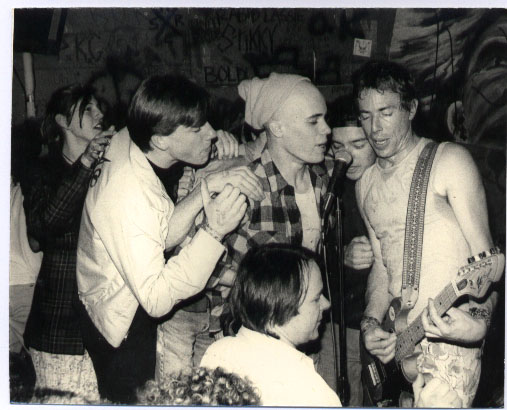
For about six months now Blogger wouldn't let me post pictures, and it's still trying to stop me doing so. But I think I may finally have found a way around its electronic obstinacy, and in trying to test my theory, I grabbed a photo at random and pasted it here. If it works - and that still remains to be seen - I guess I should say a little about the contents.

It was taken at Gilman Street, probably in late 1988 or early 1989, and almost certainly by the great Murray Bowles, who singlehandedly documented most of the early Gilman scene. Every weekend, virtually without fail, Murray would be there, the only guy in the pit with both a beard and glasses, looking more like a high school science teacher than a punk rock photographer. Between sets he'd hang out in the store or on the edge of the stage while people clustered around him waiting their turn to look through his box of photos from the previous weeks. If you saw one of your band, or your friend's band, or just one that might look cool in your fanzine or your scrapbook or the kitchen wall, it was yours for a quarter, which, Murray claimed, was exactly what it cost him to print them. Sometimes people would be so appreciative that they'd try to give him something extra, or maybe all they had was a dollar and they'd say, "Keep the change." But no, it always had to be a quarter, no more, no less.

I seldom get to Gilman these days, and I haven't seen Murray there in years - in fact the last time I saw him was on Avenue A in the East Village, outside Doc Holliday's, where he was playing a show with his country/bluegrass band, the Shitkickers. He plays the viola. I didn't ask, but I imagine in this digital age he doesn't sell a whole lot of photo prints anymore, though I could easily be wrong. He's still out there taking pictures all the time, though mostly of bands that I'm not familiar with, and tending more toward the thrash-metal side of things, which I believe Murray always had a soft spot for.

Anyway, the photo reproduced above contains a whole raft of Gilman luminaries. On the far left is Kamala, who you may have heard of in the context of her bands, Kamala and the Karnivores and the Gr'ups, among others, or the Screeching Weasel song, "Kamala's Too Nice." She was also a legendary tour booker back in the days before most people knew it was possible for unknown punk bands to tour the country (hence the line in the Screeching Weasel song, "Won't even ask her to book my band"), and set up the one and only Operation Ivy tour in 1988. Haven't seen her in years, but apparently she's now got a master's degree from Berkeley and is working in the field of transportation planning. Oh, and one last Kamala tidbit: when we were petitioning the City of Berkeley for permission to open Gilman Street, her dad, a very responsible and middle-class-looking fellow, came along with a bunch of us punks to make an impassioned speech to the City Council that just may have turned the tide.

Next to Kamala is Todd Wilder, who played drums in Stikky, a maniacally frantic and hilarious band who were big favorites at Gilman. They had an album out on Lookout, but it never came close to capturing what they were like in person. There are demo tapes which do a better job, but good luck finding them. Todd later went on to form a white reggae band that had some success, but that's the last I heard of him. He's leaning on the shoulders of Jesse Michaels, the singer and lyricist for Operation Ivy. Behind Jesse is Kaz, who was in a couple bands, neither of which I can remember the name of right now, and who was a constant presence at Gilman for several years. Crouching down in front is Marshall Stax, longtime KALX DJ, sometime Gilman sound man, and member of Blatz and Subincision. Marshall is also the only person I know who was at the last Beatles show (Candlestick Park, 1966) and the last Sex Pistols show (Winterland 1978).

The guy on the right, with the guitar, is me; unfortunately the other two Lookouts were obscured from view. It's impossible to tell from a photo, of course, but most likely we were singing "Big Green Monsters," a song co-written by Tre and Kain that always seemed to inspire the crowd to swarm up on stage and sing along with us. It was probably the goofiest song we did - amid a whole raft of über-serious political songs and attempts at punk anthems - but it was the one the people loved. It also helped me begin to understand that hooks pretty much always trump polemics.

03 September 2006

It's Not Easy Being Thick

Or so Kirk, long-suffering but lovable dolt, declares on tonight's episode of Coronation Street. He's going for the sympathy vote in his attempt to win back the affections of bolshie but also lovable strumpet Fiz, who had given him the boot for being too predictable and not romantic enough (yes, I know, we've all been there).

Kirk, wily grafter that he is (well, not really, but, he is, as he acknowledges, "bright enough to know I'm stupid"), counters by presenting Fiz with some allegedly original love poetry that turns out to have been cribbed from some Bread lyrics, and is busted when former entertainer Rita comes strolling into the Rovers singing that very tune (the very first time in 20 years Rita has spontaneously burst into song; what are the odds?) just as Fiz is daubing at the tears inspired by Kirk's newfound eloquence. Kirk's ready admission of guilt, his abject apology, and the above-cited plea for tolerance of the mentally handicapped do the trick, and he and Fiz live to canoodle another day.

Which is more than can be hoped for with most of the Street's star-crossed characters, but only serves to illustrate once more Oscar Wilde's dictum, "The good end happily, the bad unhappily; that is what fiction means." It's also why Coronation Street is miles ahead of EastEnders or any other show of its type, and one of the things I will miss most about England. In fact, I think one could make a case (and were it not so late at night, I might try this myself) for Coronation Street being so English that England itself sometimes seems but a pale simulacrum.*

*Yes, I know that's the second time I've used "simulacrum" in a week, and yes, I know that's no more acceptable than Wilde's using "tremulous" seven times in the first 100 pages of The Picture of Dorian Gray. But if you can find it in your heart to forgive him, please consider doing me the same courtesy, and I promise not to let it happen again.

The Sunday Papers

One of the things that originally attracted me to England and will make it difficult to leave is the quality (and quantity) of the newspapers. Yes, some of them are even more sensational and trashy equivalents of the New York Post, and yes, even the quality broadsheets indulge in levels of invective and tendentiousness that would never be tolerated in sober, august journals like the New York Times, but for me, at least, that's part of the appeal.

I used to have a neighbour who I'd see Sunday mornings staggering home under the weight of no less than 13 papers, everything from the weighty Times, Telegraph and Observer to the tawdry tittle-tattle of the Sun, Mirror, People, Star, and that acme of all scandal-mongering, the News Of The World (aka News Of The Screws). Although I must admit that the Star is offering some stiff competition, with cover stories about how "Wild Child" Peaches Geldof wants to join a cult of swinging lesbian porn stars."

On a slightly more serious note, Nirpal Dhaliwal socks it to Mayor Ken "K Diddy" Livingstone's race-pandering, Melanie Phillips sounds the alarm about homegrown Islamic terrorism (believe it or not, this woman used to write for the Guardian and look like one of Joan Baez's soul sisters from Carmel or Mill Valley, and Christopher Hitchens's grumpy brother inveighs against, well, just about everything. However, I just discovered that they want £2 to read Hitchens's column. Not worth it. Click the link to read his blog instead. And while you're at it, try Richard Littlejohn, who mines some of the same territory with less nuance, aplomb or inhibition.

Don't mean to overload you with right wing tosh this week, but the left wing version seems a bit thin on the ground for a change; even the normally reliably batty Mary Riddell has devoted this week's moanings to some pious blather about the Queen instead of her usual explanations about how we wouldn't have problems with those essentially well-meaning but misguided suicide bombers if only we'd make burqa-wearing mandatory and stopped being so horrible and patriarchal and white. Or if we'd just furnish all prospective Islamofascists with a complimentary subscriptions to the News Of The Screws...

Yuppie Playfest or Woodstock Redux?

Has anyone here actually ever been to the Burning Man festival? (You can try this link to the official Burning Man site if you want, but when I last checked, it was down; maybe too much sand in the hard drive, or the webmaster is still crawling around somewhere out there in the stoned out trackless wastes of Nevada and/or his mind. According to this account, some 43,000 people ponied up the $250 entrance fee, and this has been going - if not on quite so large or expensive a scale - for over 20 years now. Yet rack my brain as I might, I can't think of a single friend or acquaintance who will admit to having attended the post-hippie playfest in the desert.

Since I've always liked to believe that at least a few of my contemporaries and colleagues were of the - do they still call it this these days? - cutting edge persuasion, I find this a bit curious. Could it be that the crowd I run with is far more bourgeois than I imagined? Or is it more likely that that Burning Man is, as this account posits, "a nudie dopefest...in which project managers play at being free-love hippies for a week"?

My instincts have always gravitated toward the latter explanation, but I'm hesitant to reach any conclusion without actually seeing the event for myself, and I'm unlikely to do that unless a) I'm on the guestlist; and b) they move it out of the desert and relocate it next to a large body of water. In the meantime I'll try to reserve judgment, a task made considerably more difficult by the enthused ravings of the SF Chronicle's boho-yuppie correspondent, Mark Morford, who has been touting Burning Man for many years now, and who, as far as I can recall, has never, ever been right about anything.

Bye Bye Bobby Christgau

If Bruce Brugmann is to be believed, the new editor of the Village Voice has finally sacked Robert Christgau, its Jurassic music critic. While I'm not generally in favour of unemployment, especially the forced variety, Christgau had just about reached retirement age anyway. Still raving about long-in-the-tooth 80s noise rockers Sonic Youth being "the best band in the universe"), he had gone beyond the role of being the embarrassing would-be hip uncle to symbolizing much of what was wrong with the Voice. The first time I picked up the Voice, which would have been sometime in the mid-60s, I found it absolutely exhilarating; for the last couple decades, it's been New York's employer of last resort for bitter and/or delusional old lefties.

Which is probably why Brugmann finds it so threatening that the Voice finally shows signs of joining the 21st century: the same "alternative" media conglomerate that recently bought the Voice has, with its SF Weekly and East Bay Express titles, been making mincemeat of Brugmann's own wildlife refuge and petting zoo for superannuated radicals, the SF Bay Guardian.

London For The Last Time?

I've been back in the UK for a total of about 28 hours now, and it's brought up a conflicting welter of feelings, some comforting and comfortable like an old pair of slippers, and others melancholy and almost wrenching, the sort that come with endings and goodbyes.
I don't yet know with absolute certainty that I'll be leaving London, but everything seems to be tending that way. It feels much the way it did two summers ago, when I spent a month in my old house in the mountains, cleaning and clearing it, and preparing it to be sold. The more work I did on it, the nicer it felt to be there, and I could hardly look out one of its many windows without seeing an incredibly beautiful view that I could barely imagine not being able ever to see again.
And on my last day there, I walked up and down the road, looking at the mountains in the distance, at the trees and flowers I'd planted, at the personal history that lurked in ever corner of the land, and tried desperately to engrave the images so vividly on my mind that something of them would linger forever. I've caught myself doing that around London yesterday and today. Not around my apartment so much- as a box-shaped council flat, it's never been exactly a thing of exemplary beauty, but even in its plainness and drabness, there's a certain at-homeness that somehow I seldom noticed before - but definitely out in the streets. All my old complaints about London come flooding back quickly enough when the trains don't run or run badly, or when the drunks come screaming down Charing Cross Road smashing bottles and sluggish pedestrians as they stumble, but they're minor irritants, really, like mosquitoes in the forest or sand flies at the beach.
And of course I'm only selling my apartment; it's not as though I'm giving up the right ever to return to London. But it won't be the same, and if I go, my chances of ever living here on a fulltime basis again are slim. I'm sure I've said it here many times before, but I have a very hard time with changes and goodbyes. It makes me wonder: if I have such difficulty leaving a city, how will I cope with it when it's time to leave this life altogether? The answer, I think, is to treat all these little goodbyes as dress rehearsals for the big one. Hopefully I'll have enough time and practice to get better at it before that comes around.

01 September 2006

Boarding In 23 Minutes

I'm at the airport now, with not much on my mind, but some extra time and a high-speed internet connection on my hands, so I guess I ought to say something. It looks as though - from a weather standpoint, anyway - I'm getting out of here just in time: the sky is sullen and threatening, and apparently what's left of Hurricane/Tropical Storm Ernesto is on its way here. Just as I was leaving the apartment, the super showed up and wanted to check the pumps underneath the bedroom floor (which I never even knew were there). Before he installed them, he said, heavy rain would usually result in the entire apartment being a foot or two under water.

Because I was running late, I thought I'd better take a car service instead of the subway to the airport. Big mistake. I'm so far out of the normal people's loop that I'd completely forgotten it was not only Friday afternoon, but the beginning of Labor Day weekend. The trip ended up taking half an hour longer than the train would have and costing seven times as much. On the plus side, I got to a) practice my Spanish; b) be introduced to some top-quality and top-volume (well, so he claimed, anyway) Ecuadorean music; c) learn some new and creative Spanish swear words. You ever wonder who that guy is that always starts honking his horn and screaming out the window if the traffic light doesn't change fast enough? Well, I can give you his number.

Still, I got here in plenty of time, didn't get strip searched, didn't get anything confiscated, and to top things off, got a free upgrade to business class for no apparent reason other than that they liked my looks (you know, now that I think about it, that probably wasn't it; maybe more like a computer error or else some important person in coach complained about having to sit next to me).

All levity aside, I'm not exactly enthusiastic about leaving New York and returning to London, but it has to be done. The way things are looking, I'll be starting the process of packing up things in the London flat and putting it up for sale, enabling me to return to New York on a permanent basis before too long. But of course that makes me sad, too: I don't want to live there, but I want to be able to live there, if that makes any sense. No, I didn't think it did either.

It's just that there's still so much to London that I haven't seen or done, but I could stay there the rest of my life and that would still be true. I just have a hard time leaving places and letting go of things, always have had. Which makes it doubly odd that I seem to have spent most of my life leaving places and letting go of things, if not just plain tossing them away. I was talking last night to an ex-con buddy of mine, who's actually spent more of his life in prison that out of it, and he used an expression I'd never heard before: "I've got a lot of rabbit in me." That meant, he explained, that whenever things got rough or complicated, he was out of there like a shot. No time wasted on explanations or goodbyes or promises to keep in touch, just gone. I could relate; a lot of my life's been like that, too. But right about now, I think I'm ready for a change.

27 August 2006

The Wedding Party

We here in North Brooklyn have been virtually marooned this weekend, cut off from the island of Manhattan by yet another shutdown of the L(oser) line. Yes, it's still possible to get to the city; if you're desperate enough you can always walk across the Williamsburg Bridge, which only takes about an hour, i.e., about as long as you might wait for an L train late at night even when the accursed thing is "running."

But I exaggerate, as usual, and in reality I appreciate the New York subway and both the L and G lines that serve my neighborhood, and if you think I'm only saying that because I want to stay on good terms with the subway gods, you wouldn't be far from wrong. Actually, I've come to believe that the subways are animate beings of a high order, with senses so finely attuned that they can hear any disparaging remarks I make, pick up on any less than positive thoughts, and punish me accordingly. It's kind of like the time many years ago when I was sitting in a restaurant near the beach in Santa Monica, dining on a filet of shark, when I stopped in mid-mouthful and thought, "In another hour or two I'll be swimming in the same ocean that this shark came out of. And no doubt he's got brothers and uncles and cousins and friends and loyal members of the shark species who just might happen to get wind of what or who I was having for dinner."

I stopped then and there, and have never taken a bite of shark meat ever since, on the very sound (I think) principle that I should not eat anything that is capable of eating me. And so far, so good. Does the same principle apply to subways, which don't so much eat people, but devour the hours and days ane weeks and months of their lives? I don't know, but it's not the kind of thing I want to risk, so let's hear it for the subways, okay? I hear they're just great!

All that to point out that I've had to take a lot of strange detours these past few days, mostly by way of Queens, but I've still managed to get into town to see Rancid a couple more times and got a chance to have lunch with Tim A. as well, which was the first time we'd been able to sit down and talk in a couple years. I mentioned how exciting it was to see the reaction to the Operation Ivy songs - here's a band that put only one album and that's been broken up for 17 years, and yet people who weren't even born when that record came out were singing along with every word. Tonight they did "Knowledge" and followed it up with an electric version of "Sound System" that was just incredible. I took along a couple of 50 year olds who hadn't been to a punk show in 10 or 15 years and they were like, "Whoa, this stuff is still going on?" But they were both seriously impressed with the quality of the music and the intensity of the crowd.

Saturday I took the night off from Rancid and instead went to Desmond's Tavern on Park Avenue for one of Chadd Derkins' periodic punk rock shows. "Are you here for the bands?" the doorman asked. "Yeah," I said. "Which one did you come to see?" "Um, I don't know. All of them, I guess." Which wasn't true; I couldn't even remember who any of the bands were. I just like to support Chadd's shows.

But something seemed strange. I practically had to fight my way in the door, the place was so crowded. I was pleased for Chadd's (and the bands') sake, but it didn't make sense. Desmond's shows are usually attended by the inner circle of New York's Pop Punk Clique and a few friends, hangers-on, and random drunks. 50 people would be a very good turnout. Yet there had to be 200 people in the place. Was one of the bands (for the record: the NoLoves, the Groucho Marxists, Project 27 and Bazooka Falcon, only two of whom I was even vaguely familar with) much more famous than I suspected?

Another weird thing: the crowd seemed exceedingly well dressed for a punk rock show. No band shirts, and lots of jackets and ties. They also seemed a little old (of course, look who's talking) for this kind of music. The mystery was solved when I finally made it to the back of room, where Chadd, Carla, and about five musicians sat, looking bemused and/or disconsolate.

"They double-booked the place," explained Chadd. "There's a wedding party that's supposed to be over at 9:30, but they don't seem in any hurry to leave." I suggested that having the bands start playing would clear out the wedding guests in a hurry, but Chadd is a kinder and more sensitive person than I am, and confined himself to pacing the floor and running his fingers through his hair with increasing ferocity. "You can tell how stressed Chadd is by how far his hair is sticking up," confided Carla.

The bands finally started playing around 10, by which time most of the wedding guests were drunk enough that they barely seemed to notice. But gradually they migrated to the front room; unfortunately, so did many of the punks. This wasn't a comment on the music, but on the fact that the overhead air conditioners were sending arctic blasts down on those of us who sat or stood huddling and shivering near the stage. I put on my jacket - the first time I'd worn one since early June - and was still freezing. The reason I even had a jacket with me? Well, I'd brought it along because it was only about 65 degrees outside.

"Chadd," I said, "go tell the bartender he can save a lot of money by turning the air conditioning off, and also on the lawsuits by frostbitten customers." Chadd did, and came back to report, "He says he can't because it'll get too hot in the front room." I made disparaging remarks about the bartender being either drunk, insane, or not having set foot outdoors in three days, and threw in a few more rude suppositions about Irishmen being congenitally thick (it's all right, I said, I'm part Irish too). But eventually I gave in and retreated to the front room myself, where I found Chris A and P Smith in a corner making even ruder Irish jokes (again, it's all right; a quick calculation revealed that the three of us added up to 5/4 of a pureblooded Irishman).

Referring to Chris A's Mel Gibson-like protestation that he never would have said, "White people can't dance" had he been sober, P Smith claimed that Chris was now arguing that the Potato Famine had never happened, that it was just a lie perpetrated by the liberal Irish media I admittedly found this hilarious, but surrounded as we were by Irish bartenders and Irish bar patrons, couldn't see it going in a positive direction, so I said so long and headed out into the night.

Out on the street, the temperature was still about 65, maybe a bit less, and it felt positively tropical. I walked up to Grand Central, marveling all the way at what an astounding piece of classical architecture the station is (and how close it came to being torn down a few years ago by the reigning philistines who did succeeed in demolishing Pennsylvania Station), and caught the 7 to the G to make my circuitous way home on the still-lovely New York City subway system (at least they'd turned their air conditioning down).

My last weekend in New York, by the way, at least for a while, and it rained pretty much all the way through. Tonight the humidity is literally 100%. I don't care. I like it here, and will miss it terribly.

25 August 2006

Fresh Meat

One of the many nice things about my street is that it is lined with trees. Lately people seem to have been trying to outdo each other by building ever nicer wooden borders around the tree in front of their house, and someone down at the end of the block recently completed the poshest tree box yet, involving numerous pieces of quality lumber and rising at least a couple feet above the sidewalk.

Possibly someone didn't appreciate his efforts, though, or perhaps there is a stranger or more morbid explanation, but when I walked past today, two hind quarters of some indeterminate animal were sitting there atop the box. Had they come from a butcher shop, or did they belong to a neighborhood dog that had gotten on somebody's nerves one too many times? It was impossible to tell, though it did look like good enough quality meat that I was halfway surprised no one had picked it up, washed it off, and served it to their family for dinner.

I was even more surprised that it didn't appear to have been touched by any of the neighborhood's four-legged creatures, including dogs, rats, or the half dozen cats that appear to live in the front garden of the library. Maybe it hadn't been sitting there that long, I reasoned, but then on the other hand, it had clearly been there long enough for someone to leave a yellow Post-it note next to it saying, "You dropped something."

Journey To The End

Uptown tonight to Times Square, a place that doesn’t normally hold much interest for me, but Rancid were playing the first of four shows at B.B. King’s on 42nd Street. Not a bad joint for what it is, though seeing the “B.B. King” emblazoned on the wall behind the stage kept making me think of the time I saw the real B.B. King (no, he was nowhere in evidence tonight) at the Ann Arbor Blues Festival in 1969, and how, when the festival got shut down by the curfew police, he simply packed up his guitar and his side musicians and moved the session over into an unoccupied building on the U of M campus and played on for most of the night. For free, too, I might add.

Anyway, this was the first time I’d seen Rancid in a venue this small (no more than 1,000 capacity, I’d guess, maybe not even that much) since the early 90s. The last two times I’d seen theme were at Roseland up the street, which holds several thousand, and at the Reading Festival, in front of more like 50,000. In a setting like the latter, the spectacle of it all often supersedes the music, so tonight was a twofold revelation, or maybe just reminder of what I probably knew all along: just how great the guys are as musicians and showmen, and what an amazing catalog of songs they’ve compiled over the last – what is it? – 14 or 15 years.

They even threw in an Operation Ivy song, as apparently they’ve been doing at various points during this tour. Tonight it was “Unity,” which sent the crowd absolutely wild, and brought up some intense emotions on the part of yours truly. I mean, I try to act all blasé about having seen Op Ivy however times, about playing with them up at Arcata and at their very last show at Gilman (their last official show, I should point out; not so many people know they played one more show in Eggplant’s backyard the following day for 50 or 100 of their friends), but sometimes it’s kind of exciting to think about. And never so much so as when Rancid blasts into “Journey To The End Of The East Bay,” the musical autobiography of Operation Ivy and the whole amazing, exhilarating, heartbreaking epoch that was (actually, still is) Gilman Street. A thousand people punching the air and singing along with every word, Tim talking about how it was "sacred ground for me," and then socking you with the punch line: “What you gonna do when everybody goes on without you?”

That one hit me hard tonight. Sometimes I feel exactly that way, that everyone else I ever knew has gone on with their lives while I’m stuck in some nostalgic time capsule reminiscing about the good old days or hoping that some new thing will come along that’s sort of enough like the good old days than I can kind of fuzz over the discrepancies and the absences.

But that’s just a feeling, and like all feelings, it passes. Yeah, maybe my life isn’t as glamorous or exciting or as rich or as sensational as I might like to think it should be, but it’s a pretty good life nonetheless. Maybe things seem a little quiet these days, but remembering the chaos I’ve dwelt in for so much of my life, I should be grateful for that. And also remind myself that through all the best and the worst times, the memorable and the eminently forgettable, I seldom had more than the vaguest clue of what was happening or where I was going until it was past and I was somewhere well down the road. No reason things should be any different today. Anyway, good show, Rancid. And when Lars introduced Matt as “the greatest fucking bass player in the world,” I was like, oh yeah, I’d almost forgotten, but yeah, he is.

Great Kills

In England, it’s standard practice for hundreds of thousands of people to spend their free time by taking a train somewhere out into the country and then walking five or ten or fifteen miles to the next town before catching the next train back. As you’ll know, of course, if you’ve been following my past blog posts about the West Country Walking Society.

That sort of activity seems a lot less common, if not downright eccentric here in the USA, but yesterday I was able to pull off an English-style expedition to the country, even if it did require taking three trains and one boat, and several miles of walking. All, I might add, without ever leaving New York City.

I spotted Great Kills Park, part of the Gateway National Park, on the map, and it looked reasonably close to the Great Kills train station. It also looked as though it had some nice beaches, so I got out my trusty mini-backpack and hopped the L and the W to the Staten Island Ferry and then on to the somewhat grandiosely named Staten Island Railway. What it is in reality is a sort of clapped-out version of a New York subway line – I think it’s where they send trains to die when they’re too old and decrepit to use on regular lines anymore.

People often say the G line, running between Queens and Brooklyn, gets no respect because it is the sole line that never touches Manhattan, but they’re wrong. The Staten Island line also never touches Manhattan (or any other borough of note), and gets far less respect. It’s dirty, only runs once every half hour, and is the only New York train line I’ve seen in more than a decade with significant amounts of graffiti.

But never mind that; it still gets you where you want to go, even if when you get there, it turns out not to be where you wanted to go at all. I mean, not to keep harping on England, but as bad as the trains can be there, it’s pretty typical for them to drop you off close to major destinations like castles or national parks or other tourist attractions, and also pretty typical for them to have a station named after or at least related to the attraction in question.

Not so with Great Kills (a kill, by the way, is a creek or a stream; sorry to disappoint you if you thought that Fresh Kills, also on Staten Island was a giant open-air abattoir or buzzard feeding ground); apparently it’s just the name of the town or district, and there were no signs pointing the way to the park, no sign, in fact that it even existed.

Luckily meandering around the English countryside has endowed me with a certain sense of direction, plus Staten Island is small enough that if you keep walking you’re bound to hit water sooner or later, which is what I did. Unfortunately, although it was the right ocean (bay, whatever), I was nowhere near the park, but I found it eventually by cutting across fields, through a whole row of private yacht clubs, and at one point into a swamp with cattails towering over my head.

So was it worth it? Well, I was definitely out in the country, the air was fresh and sweet, and apart from the moron who parked his motorcycle nearby and kept it idling so that he would have to shout louder during his half-hour conversation with another moron, awfully quiet and peaceful. The beach wasn’t bad, either, apart from a couple flaws. For one, it seemed like you had to walk out about half a mile to get in over your head. Fine for children and short people, but not so great for me. It might be all right at high tide.

The other thing, which actually made it unbearable to sit on the beach for more than a few minutes, is the horde of biting black flies that zooms in on you the minute you stop moving. I noticed other people lounging around – not many, though; at points it looked like one of those deserted tropical beaches you see in a travel agent poster, minus the palm trees, of course – so maybe they were immune to the flies, or oblivious, or maybe they had some kind of bug repellent. When I got home that night, I bought some, but will have to wait till my next beach visit to see if it works.

So I had only a brief swim before I had to flee inland, and then I started hiking the length of the park, mostly along the seashore, though stupendous amounts of trash which I assume has floated in on the tide from other environs, because I can’t imagine people going to the trouble of hauling it all to a national park and dumping it there. There were also some amazing peat bogs which I thought I might sink into and be lost forever, but didn’t, and the shells of some enormous sea creatures with fearsome-looking claws.

Eventually I was out of the park altogether without really noticing it had ended until the beach and the peat bogs sort of dissolved into impenetrable swamps, at which point I was able to clamber over huge piles of rocks and bricks and then a decaying wooden retaining wall and finally came to a gravel road that led me out through a forest and deposited me right back in the middle of suburbia. Following the advice of a fisherman, I found my way – after another couple miles – back to the railway station I probably should have gotten off at in the first place, and was on my way back to Brooklyn with aching feet and a little bit of a suntan.

At The Gym

The gym I go to is not one of the posh uptown gyms, or even one of the posh downtown gyms. It's not even a posh Brooklyn gym; it's a little grimy, machines are always breaking down, and the customers... Well, let's just say you won't be spotting too many celebrities there.

But it's cheap and relatively cheerful, and does pretty much what a gym is supposed to do. And most of the time if I go early enough, I practically have the place to myself, which is nice. But starting about 9:30 am, the place gets taken over by a gang, er, group of youngish men, maybe in their late 20s, early 30s, max. You can tell the minute they hit the front door, long before you've seen them: somebody yells, "Turn that shit UP!" and suddenly the background music switches from gym disco to hardcore rap and quadruples in volume. If you happen to be listening to you iPod, might as well switch it off and save the batttery, because you're won't be able to hear it anyway.

Then these guys – there’s usually five or six of them – spread out and pretty much take over the gym, monopolizing most of the machines and the free weights, even though they do more standing around talking and flexing their muscles than actual exercising. There’s one guy in particular who seems to be the ringleader. He’s sort of a cross between Tony Manero and Tony Danza, only less good-looking and with a bigger mouth. He doesn’t seem like a bad guy at all, but he’s one of those people who has to make a lot of noise just to let you (and maybe himself) know he’s alive.

Instead of just lifting weights, he slams them together, and then slams them into the ground when he’s finished, letting loose at the same time with an ear-piercing “YOW!” or “What it is, what it is!” before shouting at one of his buddies across the room, “You gonna lift that shit or you gonna sit there staring at it?”

His buddies are mostly Italian or Puerto Rican, though a couple of them are dark enough to have some African in them, and the other morning, one of the darker ones was standing next to Tony, who in turn was on a bench right next to me. I was concentrating on my weights and not looking at them, but I couldn’t help hearing the buddy let loose with something to the effect of, “So, I’m like, nigger, don’t tell me that shit, and the nigger’s like, I ain’t telling you no shit, so I told the motherfucking nigger to keep his nigger-ass shit out my motherfucking way” – you get the picture.

I found this kind of bemusing; here’s an African-American talking to an Italian and using the word “nigger” on an average of every three seconds, and then when Tony gets a chance to get a word in edgewise, he’s saying “nigger” right back with similar frequency. Times have definitely changed, I thought, and was reminded of the Italian guy who was recently sentenced to 15 years for beating up a car thief while calling him a nigger. The use of the racial epithet made it a hate crime, you see, even though the Italian guy tried unsuccessfully to defend himself by claiming there was nothing racist about his use of the word; that was just how “everybody” talked.

So did he have a point, I wondered? Just then I got up and noticed that the guy I’d thought was African-American probably wasn’t at all, but instead was just another Italian with a very dark suntan. That put things in a different light, I guess, even though both guys were chattering away with not just the slang but the intonation of anybody you might hear hanging out down in the ghetto. With your eyes closed, you’d never have a clue they were anything but black.

Still, my philosophy has generally been that if black people want to use the word “nigger,” that’s their right, but I’d just as soon white people avoid it. It may be common parlance these days, but I think there’s still too many people to whom that word is just plain painful. So my opinion of Tony and his buddies turned downward a notch or two.

Then minutes later a song came on the radio featuring a Donna Summer sample, and Tony literally shrieked. “Yo girl,” he shouted up at the front desk, “that’s my song, girl,” and sang along in an ear-piercing falsetto. The thing was, the “girl” he was addressing at the front desk was actually a guy, an enormous body builder guy, actually, who is as black as the ace of spades, as camp as Christmas, and gay as the Fourth of July.

So what’s up with that? I’d figured Tony as 100% hetero, and maybe at least a residual racist, yet here he is singing along with Donna Summer and dishing the “girl” dirt with Mr. Big Black Gay Bodybuilder. And nobody apart from me seems to think this is the slightest bit unusual. Actually, I’ve been in Brooklyn long enough now that I shouldn’t either.

21 August 2006

Little Russia By The Sea

I actually saw Matthew Broderick in the lead role of Neil Simon's Brighton Beach Memoir, exactly where, why or how, I can't quite remember, but it was when Matthew was just beginning to look too old for teenage roles. It was probably in San Francisco in the 1970s, which is the last time I did any serious theater-going, but never mind; I only mention it because today I visited the real Brighton Beach, way out there at the end of the B and Q lines.

Which in turn put me in mind of England, because there's a chain of DIY (home improvement) stores called B&Q, sort of along the lines of Home Depot, and their advertising slogan is, "You can do it if you B&Q it." Another even more obvious thing that reminded me of England was going to Brighton Beach; the main difference being that the train to Brighton from London costs £16 ($30) return while the fare in New York is a mere $4 (£2.20), or nothing at all if you already have a Metrocard. Either way the trip takes about an hour. Another difference is that New York's Brighton Beach consists of about a quarter-mile wide strip of whitish sand mingled with cigarette butts and broken glass while Brighton's Brighton Beach is nothing but rocks with little broken glass in evidence.

Which brings up the question: since it's obviously a great deal harder to break a bottle on sand than on rocks, how did all the glass get on New York's beach? Did someone go to the trouble of breaking bottles back in the parking lot, then sweep up the pieces and carry them hundreds of yards to scatter them on the beach, all for the sake of keeping up New York's hard-ass image? Anyway, it made walking barefoot a great adventure which I probably won't repeat next time, even though I made it with the soles of my feet intact.

Still another difference or two: the water here was reasonably warm. Not tropical, but comfortable. Maybe in the mid-70s (low to mid-20s C), whereas in England it never gets out of the teens (50s to low 60s F). On the other hand, the water seemed cleaner in England, but that may only be because it's so chilly that few people stay in it long enough to scatter their litter about.

In any event, it was nice to get to the beach again; I think it was my first time this summer, whereas last summer (which was actually last January, February and March, because I was in Australia) I went to the beach almost every day. But let's face it; New York City's beach scene, pleasant enough as it is, doesn't exactly compare to Sydney's. Still, I'm going to go back, maybe tomorrow, and this time I'm going to walk from Brighton Beach to Coney Island. I would have done it today, once I saw the inspiring sight of the Coney Island Parachute Jump, aka "The Eiffel Tower of Brooklyn," off in the distance, but it was getting too late in the day and I had to hop on the old B train back to Manhattan.

Oh yeah, Brighton Beach also advertises itself as "Little Russia By The Sea" for obvious reasons: practically everything on the main drag is in Russian, and it's also what most of the people are speaking. Walking along under the elevated train tracks thus comes across as both a time and culture warp. It's kind of reminiscent of New York in the 1950s or 60s, if New York had been relocated to the Black Sea and communism never existed, but I think I'm stretching now.

Also noted: very cheap house prices and rents, at least as compared to anywhere else in New York, which may spell the beginning of the end of Russian hegemony, because quite a few Mexicans seemed to be moving in. On a couple blocks the music and the homeboys hanging out made it feel more like the Mission than little Volgograd. Anyway, a good day out, and now I'm exhausted (lying around in the sun takes a lot out of a guy) and going straight to bed.

20 August 2006

Snakes Over Astoria

Would I have rushed out to see Snakes On A Plane the first weekend - or at all - if it hadn't been the focal point of Oliver's birthday celebration? Probably not, but I'm glad I did. Even still, I wasn't expecting to see it twice, especially not in the same day, but that too was part of the program, which I will crudely attempt to summarize as: go to afternoon showing of SoaP and memorize all the dumb/smart bits, figure out when to throw plastic snakes and planes into the air and when to shout and cheer, then go to the Astoria Beer Garden to get drunk, then return to the cinema for the late night showing during which we would make obnoxious asses of ourselves as apparently is being done all over the country in what is either a stunning, grass-roots phenomenon or one of the most clever and insidious bits of media manipulation in our times. Probably both, come to think of it.

Since I don't drink, I wasn't expecting to enjoy the Beer Garden all that much, and had no intention at all of going along for the late night repeat visit to the cinema. I figured I hang out for an hour or two, then make a graceful (well, that part's unlikely, knowing me) exit and head into the city or back home. And since it started raining shortly after we got to the Beer Garden, things looked even less promising, even though we (my half of the table, anyway) was safely sequestered under a tarp which dripped water onto the luckless other side. Rain or not, the place was packed with enthusiastic revelers, including one braying and shrieking female just behind us who could barely contain her enthusiasm, especially when the cover band launched into "I Want You To Want Me," prompting a Footloose-style frenzy on the dance floor, something which apparently almost never happens at the Beer Garden.

The quality of both the music and the dancing diminished as the evening went on, prompting an increasingly sozzled Chris A to grumble, "White people can't dance." "Quit being racist," I demanded, to which he responded, "How is that racist?" he said, "Just look at those people."

True, there were some egregious examples of the terpsichorean arts being exhibited by the 99% white crowd, but I still maintained he was being racist, no matter how white he himself is. "Okay, what if I say, 'Black people can't go to college'?" There were several sharp intakes of breath in the vicinity, and a bit of head-swiveling to see if I'd inadvertently offended anyone, but Chris, sporting fellow that he is, was willing to concede that I had a point.

Chris, like myself, was not planning on going to the late-night showing of SoaP, but as the evening wore on, there seemed less and less reason not to (apart from the $10.50 ticket price, of course). I don't know what finally persuaded him, but in my own case, I didn't want to miss the excitement when a wildly enthusiastic Chadd Derkins let loose with the bagful of plastic snakes he (okay, a number of us) had been playing with all afternoon to the delight and/or consternation of the crowd around us.

It turned out to be pretty low-key after all; the theater wasn't as crowded as we'd anticipated, and our nearest neighbors didn't look all that into the burlesque or Rocky Horror elements we'd planned. I was especially bemused by the Hispanic family next to me, who'd brought not only their two year-old daughter, but a nursing infant with them. One of the afternoon's arguments had been over whether the filmmakers had wussed out by not having the on-screen baby bitten or eaten by the giant anaconda, but considering the six or nine month old child at my elbow - who actually sat up, watched, and seemed to enjoy much of the film - it didn't seem like a good argument to revisit.

Anyway, to summarize: 10 hours, $21 on two theater admissions, $0 spent at the Beer Garden, and six separate train rides (G, 7, N x2 each) to get from Brooklyn to Queens and back again, all add up to a successful outing and suitable celebration of Oliver's birthday, even if I did just find out by reading his blog that the birthday was almost a month ago instead of the day before yesterday as I'd thought. Now I don't feel nearly so bad about not bringing his ass a present.

19 August 2006

Snakes On A Cometbus

Surely it's a heretical mingling of the sublime and profane to juxtapose one of America's longest-runing and most fiercely independent fanzines with the mass-media viral marketing hysteria which will succeed in dragging me and millions of my fellow Americans into the movie theaters this weekend.

But there you go. With nothing special to look forward to this weekend except Oliver's Snakes On A Birthday party (which promises to be very special indeed), I was lurking around the cave, er, apartment tonight when a phone call came from the elusive Mr. Cometbus, saying he was off to Manhattan to distribute copies of his new issue (Cometbus #50, the 25th anniversary edition), and did I want to come along?

Certainly, I said, and volunteered to meet him nearby so I could help him carry boxes, but with typical Cometbus vagueness and inscrutability, he insisted I meet him on a seemingly obscure street corner on the Upper West Side. It turned out to be across the street from the Seinfeld restaurant, which I found mildly enthralling, but left Aaron, not someone you would call a keen TV watcher, distinctly underwhelmed. We dropped copies off at a couple bookshops, then retreated to a cafe near Columbia where I could have sworn I'd seen Barbra Streisand and Robert Redford in The Way We Were. Possibly not, but it looked very familiar even though I'm pretty sure I've never been there before.

Then we set off to walk "a little way" along the river, according to Aaron's plan. Now there's something you need to know about traveling with Aaron, or at least something you used to need to know. Let's say, for example, you were driving up California's Central Valley from LA and saw a road sign with two arrows, one that pointed west to Berkeley, the other east to Reno. Now which way would you go, assuming that your intention was to arrive in Berkeley sometime in the near future?

If you'd ever ridden in a car or, better yet, a tour van, with A. Cometbus, you'd know, of course, that the answer would be "Reno." Not because he had any desire to go to Reno, but because following the road to Reno would, in his judgment, provide a more "interesting" way of getting to Berkeley. Of course if you had a third option available, a sign pointing straight ahead and labeled, "Trackless Infernal Wastes From Which Few If Any Have Ever Returned," well, you don't need to ask...

The point is that any trip with Aaron was likely to turn into an unpredictable adventure, something which he usually seemed to enjoy much more than whoever else got dragged along with him. But times have changed. After a beautiful walk through Riverside Park, Aaron started edging toward the subway at 79th Street. There were still more copies of Cometbus to deliver in Williamsburg. "Let's stick by the river for a while, it looks like it's going to be a beautiful sunset. Maybe we can catch the train at 59th street," I said. "Or Times Square," I muttered under my breath. It was too nice a night to be hopping right back on a train.

Then, once we'd got down by the river again, I said, "Why don't we just walk all the way down to 14th Street and catch the L to Williamsburg there?" We'd walked about an hour when Aaron said, "Wait, we've totally changed places. It used to always be me trying to lead everyone astray, and now I'm the one trying to get things done and take care of business while you're the one fucking up the program." Interesting, I thought. And true.

Anyway, we finally got to Williamsburg after a couple more adventures on stupid subway trains (the B and the D, in case you're interested) that stopped at every podunk station down the West Side and then skipped the one station that any sensible train would stop at, 14th Street, and were of course too late to drop off the magazines because the store had already closed. After standing around for about 15 minutes in hopes that it would magically open again, and arguing whether walking from South Williamsburg to North Williamsburg meant you were going "up" or "down" the street (the answer is "up," of course; just look at your globe and see whether the North Pole is up at the top or down at the bottom), actually did walk up (or down, as Aaron would have it) to North Williamsbug, where we met a kid from Long Island.

For some reason Aaron told him about my plan to start a scene war between Brooklyn and Queens, and he said, "You mean the Queens pop-punk kids? Chadd Derkins and Grivet and Grath and all those guys?" It was the first time I realized knowledge of the Pop Punk Clique had penetrated so deep into the heart of Williamsburg, and while I marveled over this, Aaron took the opportunity to slip off into the night, as is his wont. I was left holding the bag of Cometbuses, which I guess it's going to be my responsibility to deliver tomorrow en route to Snakes On A... that movie. Then I went and curled up in a booth at the diner and read about half of the new issue. It's a classic, I reckon.

That #*^$@&%#@ Cube

Many of my New York friends get a kick out of my near-irrational antipathy for the piece of abstract art, generally known as "The Cube," that has been rather pointlessly hanging about in Astor Place since my own days as an annoying, stoned-out, St. Mark's Place hippie scrounger back in 1968.

To be fair, The Cube is not completely pointless; it's provided endless hours of amusement to several generations of stoned and drunk hippies and punks who've sat at its base, gaped upward at it, and in their more energetic intervals, spun it around on its axis. Alternatively, on those occasions when the axis jammed and The Cube would turn no more, they could ponder whether it had actually ever turned, or if they had merely hallucinated the experience.

But just what when I had begun once more to make my peace with The Cube, I chanced upon a plaque installed at its base. The thing, it turns out, is not called The Cube after all, but The Alamo. The Alamo? What the hell does the Alamo have to do with a pretentious, pointless piece of "sculpture" that somebody hornswoggled the City into acccepting as a "donation?" I donate pieces of junk to the City every week via my trash can, but nobody feels compelled to set them up in the middle of a heavily traveled intersection. When I think of the Alamo, I think of Mexicans and massacres and Davy Crockett, not big black steel boxes. And speaking of which, before it was renamed "Alamo" (by the artist's wife, moved by its "imposing size and impenetrable strength;" unfortunately for the Texans slaughtered there by Santa Ana, the original Alamo was slightly less impenetrable than the #*^$@&%#@ Cube), the Astor Place Monstrosity was called "Sculpture In Environment."

You want to know how lame it is to have to name your alleged sculpture "Sculpture"? It's like painting a picture and titling it "Art." Obviously you're concerned that if you don't tell somebody that it's supposed to be sculpture, some untutored doofus will leap to the obvious conclusion that it's nothing but a big black box.

But no sense stewing about it now. The City has just splashed out $37,000 on restoring The Cube to its original non-existent glory, and it will probably be with us for centuries to come. The best we can hope for is that more people like these folks will periodically apply themselves to redecorating it. Ideally with Harry Potter's Invisibility Cloak.

And Tell Me What Street...

I almost forgot to note that my new internet shoes are also waterproof, which came in very handy on my walk around Lower Manhattan with Chris A and P Smith. Not for walking through puddles, as we've had very little rain lately, but for navigating the more-flooded-than-usual bathroom floor in Ray's Pizza on 3rd Avenue.

That was our next-to-last stop on a peripatetic ramble that took us from Union Square, down along the East River nearly to Wall Street, and, via a series of seemingly aimless zigzags past Chinatown, through Little Italy, Soho, the Bowery and the East Village, back to Union Square. I'm not too keen on Union Square myself, though it's popular with the Astoria crew; I finally concluded that there was no rational explanation for this devotion apart from the fact that it's the first thing they see when they get off the subway from Queens. I, on the other hand, usually get off a the corner of 1st Avenue and 14th Street, but as have yet have formed no unnatural attachment to that intersection.

I've also realized that the reason Union Square leaves me cold, or at least cool, is not just that it functions as an open-air makeout chamber for NYU students with uncooperative roommates, but that it's on the wrong side of 14th Street. It may seem like a small detail (probably because it is), but 14th Street is the line of demarcation between Downtown and Everything Else. Manhattan is a wondrous isle, all right, but the farther north one goes, the more stretched and vapid it risks becoming. Yes, it is replete with marvels, but many of these marvels are separated from one another by block after block of colorless, anonymous megaliths and their similarly colorless, anonymous occupants. Would I live there nonetheless if I could afford it? Yes, maybe if you twisted my arm, but since that's unlikely to happen, I'll go on sneering.

I'm also disappointed to learn that "peripatetic" may not, as I was informed the other day, mean "wandering at great length only to arrive back where one began," because that takes a bit of the peripatetic-ness out of our ramble's having begun and ended at Union Square. But minor cavils aside, it was a brilliant night out, the weather was perfect (as it has been almost every day lately), and it was topped off by a black-and-white (chocolate and vanilla swirled) cone from my favorite ice cream emporium in the city, the Belgian Fries (they're hideous and smelly and repulsive, don't buy them) joint on Avenue A between 7th and 8th, across from Tompkins Square.

For Chris A, however, the highlight must have come earlier when a moderately dazzling blond model crossed paths with us on a Soho sidewalk just as some beefy besuited businessman type was trying to pick her up (well, that's how I interpreted it, anyway). Once she was out of earshot, Chris could barely contain his excitement as he told us that she was someone called Alison from the TV show Project Runway, of whom and which Chris is an avid fan. And, as P Smith somewhat waspishly observed, possibly the only straight male in existence about whom that could be said.

This reference to Chris A's flagrant metrosexuality must have tipped me over the edge, because I started singing - or trying to sing, as I couldn't quite remember the words - to Rodgers and Hart's "Manhattan." You know, "We'll have Manhattan, the Bronx and Staten Island, too..." etc., etc. The line that got me started was, "And tell me what street compares to Mott Street, in July? Sweet pushcarts gently gliding by," inspired by P Smith's more than slightly squeamish aversion to the various smells that have apparently been wafting forth from said street for a century or more.

But though my vocal efforts didn't meet with unanimous approbation - despite Chris A and P Smith being too well-bred to do more than grimace, they managed to make clear their utter lack of enthusiasm - I do suggest you click on the link to check out the full four verses of that classic tune. The couplet, "We'll go to Yonkers, where true love conquers," one of the 20th century's more strenuous lyrical stretches, is by itself worth the price of admission.


My Internet Shoes

Maybe it's only because the majority of my life unfolded before anyone had even heard of the internet, let alone understood what it might be good for, but it took me a long time to accept the idea of shopping online for shoes.

Airplane and concert tickets, sure, books, no problem. I even bought a laptop for myself and a DVD player for my brother over the internet. But shoes? That somehow seemed too personal, too intimate, almost. As a child, going to the shoe store to get my feet measured and the right pair of shoes fitted ("right" in my parents' minds; virtually never in mine) was almost akin to a visit to the doctor or the dentist, albeit slightly less painful.

This was mainly because I had to wear "special" shoes because of my flat feet. Or at least my father had been convinced I did, though he was always suspicious that he was being sold a bill of goods, and always bewildered me by muttering a string of anti-Semitic imprecations against that nice Mr. Cutler every time we left the shoe store, having just unloaded another $25 on a pair of oxblood clodhoppers that I'd no doubt outgrow in three or four months.

If $25 seems like nothing for a pair of shoes, bear in mind that a typical pair in those days cost four or five bucks, and a pair of Keds, which I was never allowed to wear, no matter how I pleaded, a mere two or three. My father once calculated that he had about a thousand bucks invested in my feet, so you can imagine how thrilled he was when I chucked out my expensive orthopedic shoes in favor of flimsy, support-less Converse All-Stars.

And for about 20 years I happily wore Converse or even cheaper, flimsier sneakers while doing no visible damage to my feet. If they'd ever been flat, they didn't seem to be now, and even if they were, I could easily walk ten or more miles without any discomfort. Then came that fateful night at Gilman, New Year's Eve, it was, when 1987 went into 1988. I was kneeling on the side of the stage watching either Operation Ivy or Isocracy when an enormous fat kid came flying out of the audience and landed on my back, bending my big toe backward and breaking it.

I refused to believe it was broken, which really meant I refused to go the emergency room to get it X-rayed because that would cost a few hundred bucks I didn't have. So I tried to walk off the pain, and continued to do so for the next fifteen years, still wearing those accursed Converse All-Stars, until I could no longer walk more than a half mile without experiencing excruciating agony. When I finally dragged myself to a doctor, he ordered me to throw out my Converse and never wear them again, prescribed expensive orthotic inserts, and gave me a very short list of acceptable footwear that I'd be allowed to wear henceforth.

So I'd gone full circle, back to wearing "special" (and expensive) shoes. Yeah, they mostly looked kind of lame, or at least kind of meh, but on the bright side, I could walk again. 15, even 20 miles, without much discomfort. But they're hard to find, and have been getting harder, so after six months of searching shoe stores in San Francisco, London and New York, I finally resorted to the internet, where it took me about 15 minutes to find these semi-stylish (well, I like them just fine) Asolo sneakers (trainers to you Brits) and another minute or two to order them.

They took a while to arrive, but when they did, I took them out of the box, slipped them on, and immediately went for a five or ten mile walk with Chris A and P Smith. Insane? Perhaps, but they fit perfectly, felt like I'd been wearing them all my life, and never caused me a moment's discomfort in all that walking. The closest thing to an awkward footwear moment was when the laces inadvertently came untied ("Better send them back," P Smith advised). In other words, I love my new internet shoes and may never set foot in a shoe store again.